I would like to know from where Roman Catholic denomination originated. Why does we have many groups like CSI, Jacobites, Orthodox, Evangelist, etc? Is it because of the believes people divide among themselves?
Asked
Active
Viewed 1,010 times
0


-
You're really asking too many things. Can you ask a more focused question? – curiousdannii Sep 29 '14 at 11:16
-
@curiousdannii - I would like to know why there is lots of caste in Christainity itself. – Niki Sep 29 '14 at 11:18
-
"caste"? What do you mean? – curiousdannii Sep 29 '14 at 11:19
-
2I think he means denominations. I also think that's been asked already, but I'm on my phone and that's too limited to search. – David Stratton Sep 29 '14 at 11:29
-
yes denominations – Niki Sep 29 '14 at 11:48
-
1@Niki : I think you are confusing Indian caste system with christian denominations. You have clarified that you have used caste and denomination to mean the same. They are not the same. There is a huge difference. I have edited the question to reflect your clarification. – Jayarathina Madharasan Sep 29 '14 at 18:01
-
@Niki Welcome to Christianity StackExchange! – Sep 29 '14 at 20:26
1 Answers
5
If you're talking caste, I'm assuming your talking about the Christian caste in India. Within castes, there are denominational differences, which this answer will discuss.
Legend says that St. Thomas - one of the original 12 apostles - made it to India in 52 AD. That's the official origin story of Christianity in India. The Christians of Nagaland and Assam, on the other hand, tend to come from the missionary efforts of Protestants in the 1800s. They both originate from the same place and actually don't differ very much on key issues like salvation, the nature of God, and how one should live. Typically, they recognize each other as Christian.
In the intervening 1750 years, the biggest question that divided the two sects of Christians was the question of papal authority. In the 1500s, Martin Luther became the figurehead of what is often called the Protestant Reformation. There was fighting and war between them, too. He railed against corrupt practices of the Roman church that even the Roman Church today agrees were bad. Protestants basically said, there shouldn't be a Pope. Roman Catholics believe in apostolic succession and do.
That's your difference.
Within Catholicism, there are different "orders" of Christians - people like Jesuits, Benedictines, etc... who subscribe to slightly different rules about how one should practice, but these are almost entirely organizational matters, and they all are in theory in submission to the Bishop of Rome.
For a more comprehensive answer on Thomatic Christians, consult this article on Christianity in India. Note, the focus there will be on "Catholics" - which could mean Oriental Orthodox (e.g. Syriac and other Nestorian) or Roman churches. Oriental Orthodox branched off in 451 AD, mostly over Christology. When it comes to philosophically understanding how Jesus was fully God, fully man, these churches all rejected the consensus in the West.
This graphic in particular shows the denominational lineages:
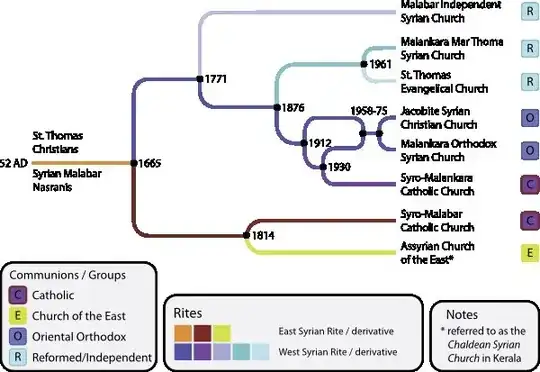
Within Protestantism, there are different groups that also have different interpretations of communion, baptism and other rites - and most importantly they don't submit to any other earthly authority, but again, the differences aren't all that great in the grand scheme of things.


Affable Geek
- 64,044
- 28
- 189
- 354
-
-
2I purposely reworded the question to keep it from being too broad or a duplicate. Plus, coming from India, I'm willing to bet he actually is thinking in terms of caste, and not denominations. In India, Christian is a caste. The differences within castes are denominational (which I explain), but I am intentionally using caste to get at what I suspect to be the OP's intent, comment notwithstanding. – Affable Geek Sep 29 '14 at 12:28
-
-
1Syrian Catholics split from the "Catholic" Church in 451 AD over the nature of who Jesus is, at Chalcedon. But, basically, yes. (Huge handwave / gloss. I know somebody, somewhere is turning over in their grave.) – Affable Geek Sep 29 '14 at 12:50
-
Then in 451 AD, other denominations like Malabar Independent Syrian Church, Jacobites, MAr Thoma, CSI, Orthodox all formed? – Niki Sep 29 '14 at 12:57
-
To get a better overview, read the link "originate in the same place" – Affable Geek Sep 29 '14 at 12:58
-
The Syriac church is an extremely minor offshoot. It was basically gone by the 900s, with the minor exception of parts of the Middle East (esp. Iraq) and India. – Affable Geek Sep 29 '14 at 13:00
-
1Beyond that, each one formed at a different time for a different reason. We are talking about a period of over 1500 years. If there is a particular denomination you are interested in, ask that as a new question. I don't really have time to write a book. – Affable Geek Sep 29 '14 at 13:02
-