6

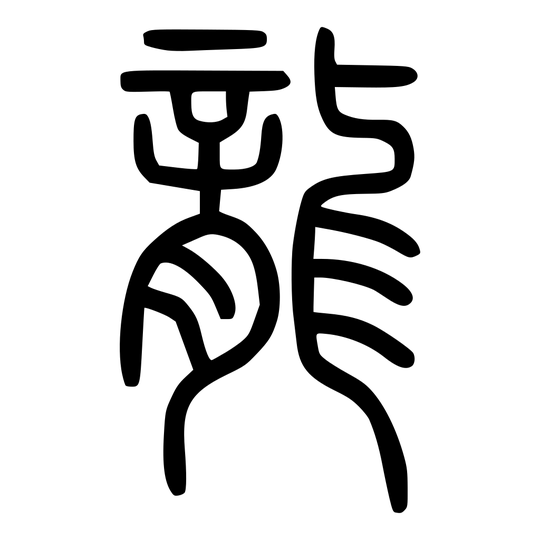
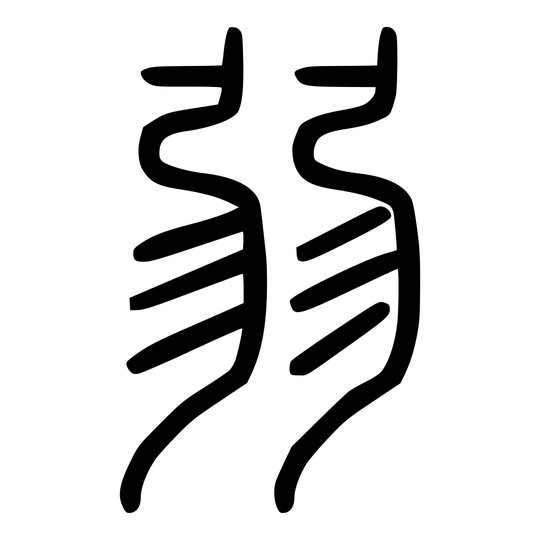
The right component of the small seal script 龍 seems to be the mirror image of the components of 弱. I know the older historical forms of 龍 do not share this similarity but I can't help but wonder if this is more than coincidence. Is there any relationship between these components?


dROOOze
  • 22,662
  • 2
  • 42
  • 65
creallf
  • 163
  • 4

2 Answers2

12

No, they're not related. The right side of 「龍」 appearing similar to a reflected version of a part of 「弱」 is a coincidence, and is an artefact of seal script shapes.

  • 「龍」 was originally a picture of a mythical animal with a long, snake-like body (pic. 1). The right side of 「龍」 is the animal's body, which later separated from the animal's head and incorporated an additional 2-3 decorative strokes (pic. 3).


    龍
    5.5
    合集6631
    春秋

    龍
    郘X鐘
    集成226
    戰國
    璽印
    龍
    0538
    古璽彙編


    龍
    龍部
    說文解字

  • 「弱」 is a reduplication of a component; this component was originally a picture of a person 「人」 urinating (indicated by a shape similar to drops of water, 「氵」). The word that the component originally represented (Baxter-Sagart OC: /*kə.nˤewk-s/) is now commonly written as 「尿」, with a less common variant 「溺」. The word meaning weak for 「弱」 (/*newk/) is a phonetic loan.

    時期
    字體
    字形|隸定 參考資料

    尿 5.1
    戰國・楚
    溺 7
    包山楚簡
    戰國・楚
    溺 老甲12
    郭店楚簡

    陶文
    弱 648
    秦陶
    宋楷 弱

    The original form (row 1) was duplicated, and in Chǔ scripts (rows 2 & 3), (a) one of the 「人」 was corrupted to 「勿」 and (b) one of the 「氵」 become a fully-fledged 「水」 (albeit, written sideways like in 「益」) and disconnected from the person. In Qín scripts (row 4), 「人」 was corrupted into 「弓」, leading to the modern 「弱」.


References:

  • 季旭昇《說文新證》
dROOOze
  • 22,662
  • 2
  • 42
  • 65
2

My conclusion after observing the two words is that they are not related.

The right component of 龍 depicts the form of a Loong with spikes on its back; while 弱 seems to relate to decorative features like 羽 (feather)

The character 弱(weak) came from the image of a decorated bow, which implies it is not as strong as a practical bow

Reference

: deogrammic compound (會意/会意): 弓 (“bow”) + 彡 (“hair, meaning "decoration" in this case”) - a decorative bow that is functionally inferior. Or it might be indicating that the bow is shaking, which implies a worn-out bow.

: Current form developed in large seal script, with serpent’s body on right (tail at upper right, legs on right)
Tang Ho
  • 78,643
  • 4
  • 28
  • 71