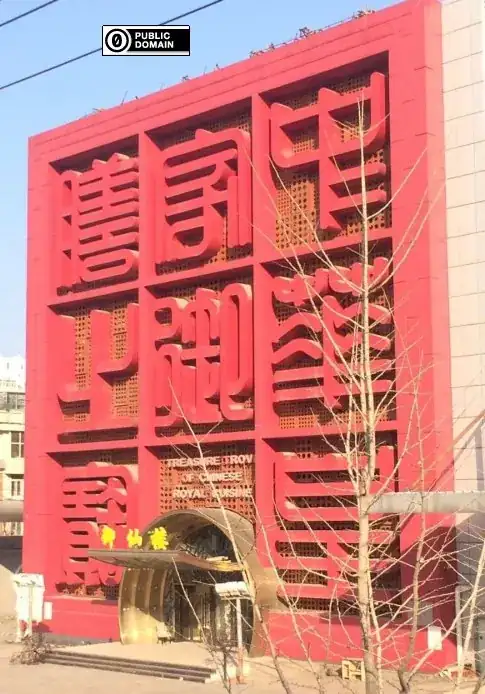
Using an excessive number of clericalified variants (隸定字), I would say that the closest characters are
蕐皇家御膳*寶
In the Shuowen Jiezi lesser seal standard, the closest characters are
中家御膳*寶
*Actually, the older structure of 「善」 is 「」 (⿱羊言), and that is what the photo and Shuowen seal form both are
In a more modern orthography,
中華皇家御膳之寶
Treasure Trove (寶) of (之) Royal (皇家御) Chinese (中華) Cuisine (膳)
There is no character where the doorway is, so there are eight characters in total. The rest of this answer will focus on the more difficult to identify characters.
中
商
甲

甲398
合集32500商
金

中且觶
集成6213西周
金

七年趞曹鼎
集成2783秦
簡

秦197
睡虎地秦簡漢
隸

唐公房碑
今
楷

「中」 depicts a military flag with flowing streamers. This was later extended to mean authority (中央), then centre, middle.
The streamers stopped being written as part of the character very early on, but sometimes they were added back in decorative scripts as horizontal lines protruding from 「中」 (, , etc.)
In contrast, 「乍」 looked incredibly different in early scripts.
華
西周
金

不栺方鼎
集成2735秦
簡

編年紀34
睡虎地秦簡東漢
隸

禮器碑
今
楷

「華」 (Baxter-Sagart OC: /*qʷʰˤra/) originally depicted a flower, now written as 「花」. The petals of the flower would be stroke-transcribed as 「」 in regular script (e.g. in the clericalified Shuowen lesser seal variant 「」). The bottom of the stalk was drawn in the shape of 「于」, which doubled as a phonetic hint (/*ɢʷ(r)a/).
Semantic 「艸・艹」 (grass) was added on later (see second form above).
「華」 was also overwhelmingly used for the meaning flourishing > magnificent, splendid (/*N-qʷʰˤra/) very early on via semantic extension from flower. The character 「花」 was invented later to represent the original sense of 「華」.
之
You're basically looking at a branch evolution here:
「之」 (/*tə/) originally depicted a foot 「止」 pointing away from an abstract place represented as a horizontal line 「一」, indicating the meaning to go. 「止」 (/*təʔ/) simultaneously hinted at the sound.
- 「之」 (to go) and 「止」 (foot) are cognate.
- Foot is now written using the derivative 「趾」.
The shape 「」 is what you find as a character component in other characters, e.g. in 「寺」 or 「志」. Normally, it is further corrupted into 「土」 or 「士」 in the modern form.
「之」 is the stand-alone character.
寶
商
金

作父癸
集成5360西周
金

父乙簋
集成3862西周
金

鄭虢仲簋
集成4025春秋
金

國差
集成10361戰國・楚
簡

221
包山楚簡今
楷

「寶」 (Baxter-Sagart OC: /*pˤuʔ/, treasure/valuables) actually had about a million variants, mainly because Chinese characters weren't standardised back then and about 90% of bronzeware had the character 「寶」 inscribed somewhere. These variants do share about half their components with 「寶」, however.
The structure which survives today contains semantic 「宀」 (building), semantic 「玉」 (jade), semantic 「貝」 (cowrie shell > money), and doubly semantic and phonetic 「缶」 (/*p(r)uʔ/, jar). The whole character indicates valuables (玉, 貝, 缶) stored inside a building (宀). If you see two or three components out of 「宀」, 「玉」, 「貝」, 「缶」 in a character, you're very likely looking at 「寶」.
The non-standardisation back then affects not only the components' presence, but the location of the components. On a component-transcription basis, the forms displayed here (listed from left to right) are, using ideographic description sequences,
- 寶 (same structure as the modern form)
- ⿱宀⿰⿱玉貝缶
- ⿱宀⿰缶⿱玉貝
- Same as 2.
- Same as 1.
「王」 and 「玉」 had different histories, but converged in shape later. As a character component, the shape 「王」 almost always represents 「玉」 (e.g. 弄, 玻). The times where the shape 「王」 actually represents 「王」 is mostly on the right hand side or the bottom of the character (汪, 皇), and these characters are pretty rare.
References: