4

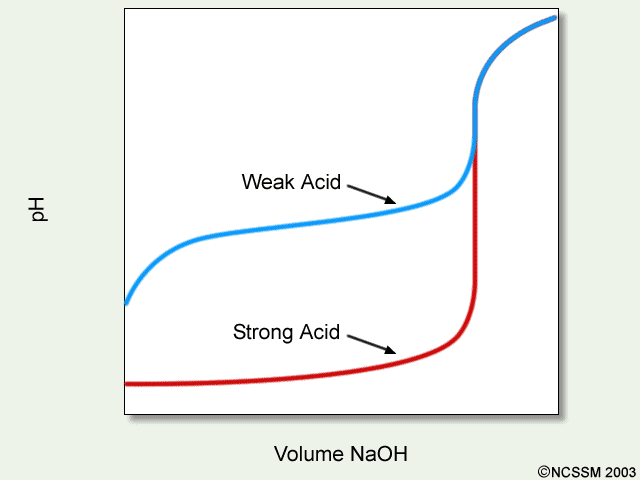
As the title says, I would like to understand chemically why this occurs. My theory behind it is that in the former case both are completely dissociated, and so at the equivalence point (and approaching it), everything is controlled increasingly by the autoionization of water, whereas in weak acids there is also a much more sizable contribution of $H^+$ by the acid itself, so the change is not as drastic. If this is correct, I'd like further explanation as to why it is, since I don't quite feel comfortable enough with it intuitively.

This is not a duplicate. I am not asking why the strong acid curve is steep, but rather why the strong acid curve is steep while the weak acid one is not.!

Weak acid and strong acid titration curves with addition of a strong base

user11629
  • 972
  • 4
  • 13
  • 20

1 Answers1

1

Compare (1) the titration of $\ce{NaOH}$ with $\ce{HCl}$ and (2) that of $\ce{NaOH}$ with $\ce{AcOH}$.

At the equivalence point of each titration, solution (1) contains $\ce{Na+}$, $\ce{Cl-}$, and $\ce{H2O}$, with negligible concentration of $\ce{H+}$ and $\ce{OH-}$. In contrast, solution (2) contains $\ce{Na+}$, $\ce{AcO-}$, and $\ce{H2O}$, and in particular $\ce{AcO-}$ will react with water to form a buffer solution of $\ce{AcO-/AcOH}$.

This will be true in general for any weak acid/base titration. The resulting buffer resists changes in pH; hence a weak-acid titration curve is not as steep at the equivalence point as is a strong-acid titration curve.

a-cyclohexane-molecule
  • 5,481
  • 4
  • 30
  • 49