8

Why is the C-S bond in $\ce{CH_2SH^-}$ longer than in $\ce{CH_3SH}$? Wouldn't there be resonance in the former, forcing the C-S bond to contract?

http://www.nrcresearchpress.com/doi/pdf/10.1139/v75-431

enter image description here

enter image description here

Also while we're at it are there any non ab initio calculations/empirical studies on this interesting thiol ion?

Dissenter
  • 18,815
  • 49
  • 177
  • 341
  • Out of curiosity, what is this paper - can you give a DOI link I'm curious what level of theory was done. A naive thought is that there might be some triplet character to the anion. – Geoff Hutchison Oct 22 '14 at 15:25
  • Also there will be syn- / anti- (or cis-/trans-) geometry issues with $\ce{CH2SH-}$ that may not have been considered (i.e., I suspect each form will have slightly different bond lengths .. essentially due to differences in the double-bond resonance picture) – Geoff Hutchison Oct 22 '14 at 15:27
  • @GeoffHutchison isn't that what you have TAs for? Sorry here's the correct link: http://www.nrcresearchpress.com/doi/pdf/10.1139/v75-431 – Dissenter Oct 22 '14 at 15:49
  • I'm most interested in empirical calculations lol. Because if I show my prof this paper I will get an earful about computational chemists, ahem, I mean "chemists." That's just his POV though. – Dissenter Oct 22 '14 at 15:55
  • How would you be able to measure this empirically? That is, how would you be able to make a carbon anion in the presence of a free thiol? – jerepierre Oct 22 '14 at 16:12
  • @jerepierre gas phase? And keep the concentration very low. I don't think the carboanion will form a three-membered ring and eat its tail. – Dissenter Oct 22 '14 at 16:14
  • Starting from what though? – jerepierre Oct 22 '14 at 16:17
  • On a different topic, can you explain what you find interesting about this compound? – jerepierre Oct 22 '14 at 16:18
  • Start from $\ce{H3CSH}$? You're right though I can't see what would selectively remove a methyl proton rather than a thiol proton. So are you saying it's impossible? – Dissenter Oct 22 '14 at 16:18
  • Why is the C-S bond length of the anion longer than the C-S bond length in the neutral thiol? Despite the possibility of resonance. – Dissenter Oct 22 '14 at 16:19
  • In any case @GeoffHutchison I don't mean to offend you, if that wasn't clear in my previous post about what my prof thinks. That's what he thinks, not me. Personally I'd like to prove my prof wrong about sulfur's bonding tendencies (hence this question ...) – Dissenter Oct 22 '14 at 18:43

2 Answers2

6

Quick Summary

The linked paper (from 1975) is probably wrong. A slightly more recent paper (J. Am. Chem. Soc., 1989, 111 (21), pp 8112–8115) suggests the bond lengths are about equal. Some quick calculations (below) using multiple modern methods suggest that, as expected, the C-S bond length in $\ce{CH2SH-}$ is shorter than in $\ce{CH3SH}$.

For both older papers, the computational results (using basic Hartree Fock) would be considered highly suspect under modern peer review, since Hartree Fock is known to have problems with anions. Certainly the 1975 paper doesn't even mention the basis set.

Seen below, it's clear that the results are method dependent, but the best current methods, with reasonable basis sets indicate the bond length is at least slightly shorter due to some partial double-bond character.

More Details

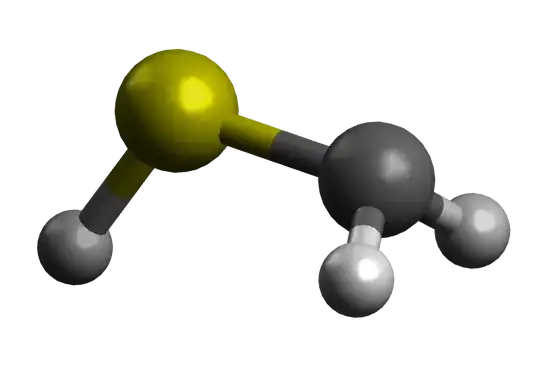
The first thing to consider in this is that there are two forms of $\ce{CH2SH-}$, syn and anti, based on the orientation of the formally C-bound anion and the SH group:

syn form

syn-CH2SH- anion

anti form

anti-CH2SH- anion

These will have different bond lengths, since the anti form will have contribution of resonance structures II and III from Ron's answer. This gives some double-bond character and should likely have a shorter bond, although electrostatic repulsion could also be invoked.

The syn form won't have a clear effect, since the C anion lone pair and the S lone pairs are on the opposite side of the bond. My guess is that the bond length is about the same as $\ce{CH3SH}$.

I think the clear message is that we can explain a lot of things, but it's better to know if our results are accurate before trying to explain them.

What I see with more modern computational methods is that the syn form has similar C-S bond length to $\ce{CH3SH}$ and the anti form is slightly shorter. I suspect the previous result is simply wrong. Calculations involving anions are tricky, since the extra electron is usually highly diffuse. I expect the basis set was simply insufficient.

The difference in energy between the two forms is ~1 kcal/mol, so experimentally, these will interconvert readily, and an average bond length would be observed. As mentioned in the comments, this species would probably be hard to observe, even in the gas phase, since $\ce{CH3S-}$ is more stable.

Computed C-S bond lengths (in Å):

For all methods, full geometry optimization was performed using the methods indicated. I would consider the CCSD calculations to be high quality.

bond length table

Geoff Hutchison
  • 27,740
  • 3
  • 79
  • 145
  • Is it possible to make -H2CSH – Dissenter Oct 22 '14 at 20:24
  • Bleh. I'll make a better table later. Suffice to say that the results are method dependent, and the syn form is about the same as CH3SH. I'll give better results later. – Geoff Hutchison Oct 22 '14 at 20:25
  • @GeoffHutchison Geoff, in water the 2 lone pairs are hybridized differently, one in a mostly p-orbital, the other in a roughly sp-orbital. How are you treating the lone pairs in your calculations? – ron Oct 22 '14 at 21:02
  • 2
    @ron These are MO calculations with full $C_s$ symmetry for the $\ce{CH2SH-}$ anion, and thus there's no notion of hybridization of lone pairs in these calculations. – Geoff Hutchison Oct 22 '14 at 21:20
  • I wonder about the energy difference between syn and anti. It can't be much and most likely might be considered as a free rotation, hence averaging would be appropriate. – Martin - マーチン Oct 23 '14 at 04:30
  • The energy difference seems to be ~1 kcal/mol regardless of method, and so averaging would certainly be appropriate. However, it's interesting that the C-S bond length difference is sometimes fairly significant. – Geoff Hutchison Oct 23 '14 at 13:01
3

First, the difference we are talking about is only 0.074 A, it's always difficult to be sure what causes such small changes. That said...

The amount of negative charge on the carbon atom in $\ce{CH3-SH}$ (-0.639) surprises me; it's actually more than in the corresponding anion $\ce{CH2^{-}-SH}$ (-0.620). Note too the significantly greater positive charge on the carbon hydrogens in $\ce{CH3-SH}$. Perhaps this suggests that hyperconjugated resonance structures like I are important in $\ce{CH3-SH}$. This would result in the $\ce{C-S}$ bond being shortened to begin with.

enter image description here

Then, in the case of the anion, resonance structures II and III suggest that there is appreciable negative charge on both carbon and sulfur, consistent with the high $\ce{q_{b}}$ and $\ce{q_{c}}$ values reported in Table I (-0.620, -0.328, respectively). The appreciable negative charge on both carbon and sulphur, in the anion, results in coulombic repulsion and a slight elongation of the carbon-sulphur bond, from the somewhat shortened bond length observed in the neutral compound.

ron
  • 84,691
  • 13
  • 231
  • 320
  • Can you think of anyway we can study this thiol ion empirically? – Dissenter Oct 22 '14 at 18:39
  • I would run calculations on the corresponding thioethers and see if the same pattern holds. If it does, the anion should be accessible from the thioether. – ron Oct 22 '14 at 18:43
  • How would you go from the thioether to the thio-anion? I'd imagine having to cleave the S-R bond ... but then ... we'd have to stick a proton in place of the R to make S-H. How can we selectively put the H on the S rather than on the CH2(-)? @ron – Dissenter Oct 22 '14 at 18:45
  • We're not putting a proton on S. We'd simply pull a proton off of the methyl in the thioether, that's all, and then we would have a carbanion alpha to sulfur. – ron Oct 22 '14 at 18:49
  • but then we have a inductively donating methyl stuck on the sulfur's other side too. The thing I was thinking about earlier with someone was how do we make -CH2SH so we can study it empirically? Any protecting groups to protect the thiol's proton? And any way to selectively put back the proton on the S? – Dissenter Oct 22 '14 at 18:50
  • @Dissenter Correct, that's why I said I'd do a calculation first to make sure the shortening effect still occurs in the thioether series. – ron Oct 22 '14 at 18:51
  • can we though make -CH2SH? – Dissenter Oct 22 '14 at 18:53
  • @Dissenter It's CH3SCH3 that I'm referring to. – ron Oct 22 '14 at 18:55
  • I understand, I'm just curious if synthesis of the anion is possible – Dissenter Oct 22 '14 at 19:04
  • Specifically the H2CSH anion, since you clearly know more about protecting groups. Or are the realities of acid/base chemistry inescapable? I'm thinking that a smart-ass answer would be yes, of course we can make it, just ionize a million moles of CH3SH and hope that probability is in your favor! – Dissenter Oct 22 '14 at 19:04
  • 1
    @Dissenter Yes, I suspect it could be generated in the gas phase, but would rearrange very quickly (it is sooo downhill from CH2- to RS-), perhaps too quickly to make whatever measurements are needed. – ron Oct 22 '14 at 19:08
  • Can we zap one molecule in isolation and hope for the best? – Dissenter Oct 22 '14 at 19:20
  • There's a paper suggesting it might be stable, but I find no manuscripts on this experimentally, except in mass spec fragmentation. – Geoff Hutchison Oct 22 '14 at 19:21
  • 1
    Dissenter asked, "Can we zap one molecule in isolation and hope for the best?" That's what the gas-phase experiment is. But like I said, I would have guessed that intramolecular 1,2 hydrogen shift from S to C would be too fast to allow enough time to record a microwave spectrum (to determine bond lengths) of the initially generated carbon-based anion. But @GeoffHutchison 's reference suggests an appreciable barrier (46 kcal/m) has been calculated for the hydrogen shift in the corresponding oxygen case. I guess that's why we do experiments. – ron Oct 22 '14 at 19:40
  • 1
    @ron I'd even guess there's a significant H tunneling rate in the syn form (or an inversion from anti to syn followed by H shift). So I agree it would at least be tough. Unfortunately, my microwave expert retired a few years ago, so I can't ask. – Geoff Hutchison Oct 22 '14 at 20:41