1

A solution of Buckminsterfullerene $\ce{(C60)}$ is shown below:
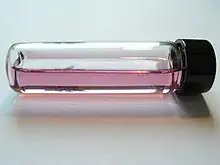
C60 solution

According to the April 8th Wikipedia page on Buckminsterfullerene $\ce{(C60)}$:

Solutions of pure C60 have a deep purple color which leaves a brown residue upon evaporation. The reason for this color change is the relatively narrow energy width of the band of molecular levels responsible for green light absorption by individual C60 molecules. Thus individual molecules transmit some blue and red light resulting in a purple color. Upon drying, intermolecular interaction results in the overlap and broadening of the energy bands, thereby eliminating the blue light transmittance and causing the purple to brown color change.[36]

Now, I'm not too bright in the field of quantum chemistry/electrochemistry, so this doesn't click with me very well. Does anyone have a good way to explain in layman's terms why the $\ce{C60}$ solutions appear pink/purple? I'm very curious why they experience such a definite color absorption when they are made solely of carbon atoms, while most organic dyes have a host of other heteroatoms and functional groups. Also, why do they exhibit a very specific absorption only when in solution? Any and all contributions are greatly appreciated.

mpprogram6771
  • 1,298
  • 1
  • 8
  • 29
  • 1
    https://en.wikipedia.org/wiki/Stacking_(chemistry) – Mithoron Apr 08 '20 at 15:58
  • 1
    For starters, that wp section is terribly written. "band of molecular levels" is balderdash as much as the term "transmittance". – Karl Apr 08 '20 at 15:59
  • 1
    @Karl Yeah, I knew it couldn't have just been my less-than-perfect electrochem skills that were confusing me. – mpprogram6771 Apr 08 '20 at 16:06
  • 2
    All pi systems have an absorbance due to the possible electronic excitation from the HOMO to the LUMO. The larger the pi system, the lower the energy, particle in a box and so on. Rings a bell? Benzene in the UV, azulene is blue, beta carotene yellow, etc. – Karl Apr 08 '20 at 16:21
  • 1
    related https://chemistry.stackexchange.com/questions/27609/iodine-color-change-in-different-complexes https://chemistry.stackexchange.com/questions/60055/pi-electron-stacking-how-does-it-work – Mithoron Apr 08 '20 at 16:28
  • @Karl Ah, Thanks Karl! That makes more sense. So the particular pi orbital arrangement for C60 allows for a specific green absorption when in solution, and then I guess pi stacking in the crystalline form blurs the line? – mpprogram6771 Apr 08 '20 at 16:50
  • In the solid, the molecules are close enough to each other that energy emitted by one can be absorbed by another instead of leaving the solution. Vibrations also have an effect and are different in the solid. Regarding heteroatoms and UV/vis absorption: Pentacene and tetracene are just multiple fused benzene rings (no heteroatoms) in a flat molecule and strongly colored. – TAR86 Apr 08 '20 at 17:49
  • @TAR86 I guess there are a few other dye molecules with only carbon. Thanks for the tip! – mpprogram6771 Apr 08 '20 at 17:51
  • 1
    The solid form of many coloured species appears different to that in dilute solution. Some of this may be due to $\pi-\pi$ interaction in the solid or dielectric effect causing solvent shifts when dissolved, but more likely is due to the huge absorption that occurs in a solid compared to solution. This changes how we perceive the colour as many more wavelengths are completely absorbed than in dilute solution and only relatively few wavelengths reflected back to us. Solid C60 appears as a fine black powder. – porphyrin Apr 09 '20 at 08:24
  • @porphyrin Oh, duh! I guess I just was overthinking it. Thanks!

    BTW, you might want to consider posting that comment as an answer. ;)

    – mpprogram6771 Apr 09 '20 at 15:27

0 Answers0