SMILES is insufficient
SMILES strings do not encode 3D structure information. They only convey atom type, connectivity and bond types. InChI is like SMILES in this regard.
Thus, you will need either (a) an algorithm to infer or guess a plausible 3D conformation of a molecule or (b) a file type that has already specified the 3D arrangement of the molecule.
File types for storing, reading, and showing 3D conformations
Probably the most standard way to represent the 3D conformation of a molecules is with a *.mol file. There are many tools to read such files. You can read more about the format on Wikipedia.
Estimating a conformation from SMILES
You can also use computational tools to estimate a 3D conformation from a SMILES string. Note I say a conformation rather than the conformation; molecules can in general have many valid conformations. Also, tools for generating conformations rely on molecular force fields, etc. These have many implicit assumptions; there is no guarantee that a computationally generated conformation will be the real conformation of a real molecule in the real world.
Here is some code for generating a plausible conformation from a SMILES string using rdkit.
from rdkit import Chem
from rdkit.Chem import AllChem
from rdkit.Chem import Draw
from rdkit.Chem.Draw import IPythonConsole

my_mol = Chem.MolFromSmiles('NC(=N)N1CCC[C@H]1Cc2onc(n2)c3ccc(Nc4nc(cs4)c5ccc(Br)cc5)cc3')

my_mol

my_mol_with_H=Chem.AddHs(my_mol)

AllChem.EmbedMolecule(my_mol_with_H)
AllChem.MMFFOptimizeMolecule(my_mol_with_H)

my_embedded_mol = Chem.RemoveHs(my_mol_with_H)

my_embedded_mol

print(Chem.MolToMolBlock(my_embedded_mol))
The printed result is:
    RDKit          3D

 33 37  0  0  0  0  0  0  0  0999 V2000
   -8.0789   -0.7261   -1.9565 N   0  0  0  0  0  0  0  0  0  0  0  0
   -8.3618   -0.9375   -0.6556 C   0  0  0  0  0  0  0  0  0  0  0  0
   -9.4453   -1.5737   -0.3799 N   0  0  0  0  0  0  0  0  0  0  0  0
   -7.4690   -0.4468    0.2422 N   0  0  0  0  0  0  0  0  0  0  0  0
   -7.8136   -0.1283    1.6244 C   0  0  0  0  0  0  0  0  0  0  0  0
   -6.7632    0.8908    2.0392 C   0  0  0  0  0  0  0  0  0  0  0  0
   -5.5246    0.3855    1.3227 C   0  0  0  0  0  0  0  0  0  0  0  0
   -6.0688   -0.0733   -0.0461 C   0  0  1  0  0  0  0  0  0  0  0  0
   -5.2554   -1.2432   -0.6177 C   0  0  0  0  0  0  0  0  0  0  0  0
   -3.8658   -0.8320   -0.9216 C   0  0  0  0  0  0  0  0  0  0  0  0
   -3.6647   -0.1417   -2.0770 O   0  0  0  0  0  0  0  0  0  0  0  0
   -2.3059    0.1587   -2.1237 N   0  0  0  0  0  0  0  0  0  0  0  0
   -1.8139   -0.3885   -1.0000 C   0  0  0  0  0  0  0  0  0  0  0  0
   -2.7692   -1.0082   -0.2227 N   0  0  0  0  0  0  0  0  0  0  0  0
   -0.4078   -0.3427   -0.6136 C   0  0  0  0  0  0  0  0  0  0  0  0
    0.0488   -1.0902    0.4772 C   0  0  0  0  0  0  0  0  0  0  0  0
    1.3984   -1.0569    0.8486 C   0  0  0  0  0  0  0  0  0  0  0  0
    2.3307   -0.2688    0.1543 C   0  0  0  0  0  0  0  0  0  0  0  0
    3.6731   -0.3282    0.5615 N   0  0  0  0  0  0  0  0  0  0  0  0
    4.8291   -0.0477   -0.0843 C   0  0  0  0  0  0  0  0  0  0  0  0
    5.9334    0.1757    0.5968 N   0  0  0  0  0  0  0  0  0  0  0  0
    7.0123    0.4129   -0.2413 C   0  0  0  0  0  0  0  0  0  0  0  0
    6.7153    0.3213   -1.5854 C   0  0  0  0  0  0  0  0  0  0  0  0
    5.0623   -0.0682   -1.7942 S   0  0  0  0  0  0  0  0  0  0  0  0
    8.3378    0.7031    0.3040 C   0  0  0  0  0  0  0  0  0  0  0  0
    9.3324    1.3464   -0.4485 C   0  0  0  0  0  0  0  0  0  0  0  0
   10.5913    1.6060    0.1057 C   0  0  0  0  0  0  0  0  0  0  0  0
   10.8633    1.2259    1.4171 C   0  0  0  0  0  0  0  0  0  0  0  0
   12.5638    1.5736    2.1593 Br  0  0  0  0  0  0  0  0  0  0  0  0
    9.8883    0.5951    2.1844 C   0  0  0  0  0  0  0  0  0  0  0  0
    8.6313    0.3380    1.6284 C   0  0  0  0  0  0  0  0  0  0  0  0
    1.8659    0.4742   -0.9343 C   0  0  0  0  0  0  0  0  0  0  0  0
    0.5160    0.4406   -1.3141 C   0  0  0  0  0  0  0  0  0  0  0  0
  1  2  1  0
  2  3  2  0
  2  4  1  0
  4  5  1  0
  5  6  1  0
  6  7  1  0
  7  8  1  0
  8  9  1  1
  9 10  1  0
 10 11  1  0
 11 12  1  0
 12 13  2  0
 13 14  1  0
 13 15  1  0
 15 16  2  0
 16 17  1  0
 17 18  2  0
 18 19  1  0
 19 20  1  0
 20 21  2  0
 21 22  1  0
 22 23  2  0
 23 24  1  0
 22 25  1  0
 25 26  2  0
 26 27  1  0
 27 28  2  0
 28 29  1  0
 28 30  1  0
 30 31  2  0
 18 32  1  0
 32 33  2  0
  8  4  1  0
 14 10  2  0
 33 15  1  0
 24 20  1  0
 31 25  1  0
M  END
A semi-interpretable 2D image of this 3D conformation, also generated by rdkit, is shown below. For comparsion, the "un-embedded" molecule, optimized to look nice on a 2D display, is also shown.
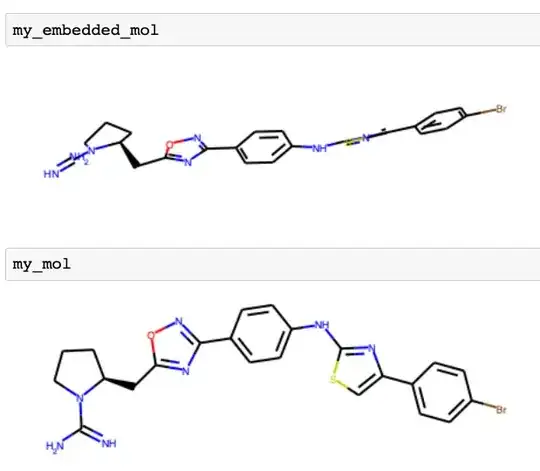
From the admittedly not-great 2D depiction of the embedded molecule, you can at least tell that the various aromatic rings are not coplanar. For better visualization of 3D conformations, you would want to use a tool like py3dmol.
RDKit is just one example of a software with these kinds of capabilities. I used it here because it's the one I know. OpenBabel is another one, as Martin rightly mentions in the comments.


Standard InChI? – 0x90 Jul 24 '19 at 17:21=), triple (#) bond and aromaticity with C, N, O, S (C1CCCCC1is not the same asc1ccccc1)) and may indicate molecular configuration (cis / trans double bond by/or backslash ; S or R atom centered chirality by@or@@). It is less frequent to see the notation including configuration, but it is present. – Buttonwood Jul 24 '19 at 23:51CCOandOCCboth represent ethanol for example. – Curt F. Aug 04 '19 at 17:20