6

I think I know some of these, but the rest are a translation muddle. The west seems to not attempt to translate nirvana, sangha, dharma, mantra, mudra, buddha, bodhisattva (and probably a few more) and that for me is actually helpful. I expect that some of these correspond to multiple Pali/Sanskrit words.

Enlightenment. In English, it is an anachronistic reference to the European age of Enlightenment.

Meditation. This word predates the west's contact with Buddhism. I have no idea what non-Buddhist baggage it brings along.

Loving-kindness. This sounds like Christianity projected on Buddhism.

Soul. Seems like this is atman, but everyone seems determined to call it something like "self," which is for a man-in-the-street just a reflexive pronoun. (Does the self exist? Well, as much as any other pronoun, like "he" or "they")

Reincarnation/rebirth. Synonyms in man-in-the-street's English, but I've seen people argue passionately how Buddhism believes one but not the other, sort of like believing in leasing but not renting (which are synonyms).

Repentance. I know for sure this is a big deal in Chinese Buddhism.

Pure/Purity. Means scrubbed clean of earthly dirt. I know this is a metaphor, but somehow, after 2000 years it falls as flat as if I tried to use a computer metaphor to explain to a 500BC farmer how the brain and cellular DNA works.

Heaven/Pure Land. Sukhāvatī comes to mind, but I'm not sure if this is a specific pure land, or the jargon for pure lands in general. Again, 'pure' makes it sound either homogenous or really well scrubbed, like a hospital. I'd rather just use whatever jargon word the originators used.

Deity. This in man-in-the-street English mean a god, or God, just like the one's the Christian's pray to. In Vajrayana, people seem to argue that yidams are something else.

Lowbrow
  • 7,152
  • 21
  • 32
MatthewMartin
  • 7,143
  • 2
  • 28
  • 61

2 Answers2

2

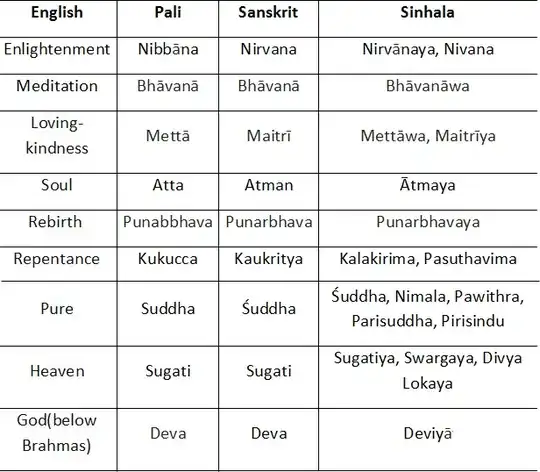
enter image description here

There are many synonyms to the words given in the table. Only mentioning some of the popular words.

Sankha Kulathantille
  • 25,668
  • 1
  • 22
  • 64
  • According to the discussion under this question: http://buddhism.stackexchange.com/a/3062/760 the translation of "enlightenment" should be bodhi, not nibbana. – michau Aug 31 '14 at 06:56
  • The distinction made there is with regards to Magga & Phala nana. More at: http://www.accesstoinsight.org/lib/authors/mahasi/progress.html

    But the word 'enlightenment' is commonly used to refer to Nibbana.

    – Sankha Kulathantille Aug 31 '14 at 07:47
2
  • Enlightenment - bodhi (awakening), vimokṣa, vimukti (liberation).
  • Meditation - bhāvanā (cultivation), samādhi (concentration), śamatha (calmness), samāpatti, dhyāna.
  • Loving-kindness - maitrī.
  • Soul - as permanent entity which doesn't exists is ātman. Soul as psyche or mind is citta, manas, or as life force is jīvita-indriya.
  • Reincarnation - is uncommon in Buddhist discourse.
  • Rebirth - pratisaṃdhi. Where birth is jāti or bhāva.
  • Pure - śubha.
  • Heaven - deva-loka.
  • Repentance - 懺 (ch'an) which is kṣamā.
  • Pure land - buddha-kṣetra.
  • Deity - devatā.
catpnosis
  • 2,009
  • 12
  • 12
  • I think śubha means beautiful; suddha (śuddha in Skt) is pure. – yuttadhammo Aug 10 '14 at 14:11
  • @yuttadhammo 'Beautiful' is one of the meanings, but also "good (in moral sense) , righteous , virtuous , honest; pure (as an action)". – catpnosis Aug 10 '14 at 14:25
  • Sure, but it's not the best literal translation for pure, that's all. – yuttadhammo Aug 10 '14 at 14:39
  • @yuttadhammo I thought MatthewMartin meant not just some abstract purity, but purity of action and personality, where śubha is good fit. – catpnosis Aug 10 '14 at 16:26
  • What is your source for thinking that? It means literally "beautiful"; that it can be in some cases glossed as meaning "pure" doesn't make it a good fit. See http://sanskritdictionary.com/?q=%C5%9Bubha or http://dictionary.buddhistdoor.com/en/word/237402/subha or http://vedabase.net/s/subha - nowhere is it defined as "pure". – yuttadhammo Aug 10 '14 at 19:03
  • @yuttadhammo Because OP said 'clean of earthly dirt', where 'earthly' I read as mundane, and not some physical dirt. Śubha/subha is definitely have connotations of purity and cleanliness, and goodness. Sobhana cittas and cetasikas are w/o defilements, i.e. pure in ethical sense. – catpnosis Aug 10 '14 at 20:06
  • the only reference to purity in your first link is parenthetical for subha-sa~n~naa; cleanliness in the PED is for the noun form, and it's not a literal translation; goodness is also not a literal translation. Sobhana cittas are so-called because it is beautiful to be without defilements; the word still doesn't mean "pure". – yuttadhammo Aug 10 '14 at 20:51
  • I even provided links to dictionaries where it says in plain text 'purity', 'cleanliness', and 'good'. (I have even more links.) And you say it still doesn't have such meaning. Just because you don't like something doesn't make it non-existent. "Noun form", "not a literal translation" - who cares? Word does have such meaning and use (in the context of actions), literal or not. If I'm correct that OP asked in the context of ethics then word is correct. Beauty in actions or personality is purity. It's not context of beautiful dance moves or material art form. It's ethics. – catpnosis Aug 11 '14 at 12:13
  • OP was asking for "the" word for it. subha isn't it. It just doesn't mean "pure", except in the same way as, say, anavajja (non-guilt) does - i.e. obliquely. The CEPD has eleven words for pure and none of them are subha. "pure: (adj.) suddha; suci; nimmala; accha; pasanna; pūta; asaṅkiṇṇa; amissa; kevala; niddosa; anavajja." – yuttadhammo Aug 11 '14 at 12:19
  • OP was asking how some Western ideas & words, which he thinks of, and which he tried to express sometimes metaphorically (note: not literally), is correspond to words in Buddhist discourse. Not just to accidental dictionary words, but to word & ideas of Buddhist discourse. Idea of ethical (persona & actions) purity (from defilements) is 'beauty'. Nowhere I said it's exhausting meaning for purity. I'm not against other translations. I just said that śubha have such reading in particular context. Several references I provided. If some dictionary not includes that, so what? Others do. – catpnosis Aug 11 '14 at 13:21