This is a classic dilemma for almost every new practitioner of Buddhism. The question goes into so much depth and even lead to Nibbana if studied in proper detail. Apologies for the long answer, but there is no shorter way of explaining this.
First things first, everyone feels through their senses. Even the Arahath feels. Otherwise, we would be able to attain Nibbana, by severing the nervous connections. What matters to the Buddhist is not what you feel through the senses; rather, what value you assign for that sensation. Unless you are aware of the process of your mind assigning values to sensations Moha (inability to see things as they are) tricks you to either hold onto that sensation (Lobha) and form attachments or to desist that sensation (Dwesha) and form hatred/dislike towards it. Simply put, we translate the actual sensations into a totally different set of values in our mind.
Wait a minute, those values help me survive. So how can they be bad?
Of cause, some of them will help your survival. As an example moving away from dangerous situation. So, obtaining sensory data is important. But forming attachments and pursuing them or forming hatred and dislike and trying to rid them is the path to generating both 'Sansara' habits (habits that could perpetuate from this life and next) as well as Karma. In Buddhism, all forms of likes and dislikes are attachments. You form attachment to some sensation by liking it, or disliking it.
Not all attachments are bad! If these attachments help you stop the cycle of birth and death, it will bring you positive results. In fact you need such attachments to obtain Nibbana. Be warned, there is a fine line here. At some point in the path to Nibbana you have to sever these attachments. Huh? Yes even the ones which help you attain Nibbana. This is why Budhdha taught us to take Dhamma as a vessel to cross the treacherous river of Sansara, and leave the vessel at the banks rather than carrying it along.
So, how can I distinguish between good attachments and bad?
Simple, if that attachment help you to attain Nibbana, help you to understand Dhamma that is a good attachment. A productive attachment. If the attachment blocks your path to Nibbana, that is a bad attachment. Be warned, we can easily fool ourselves in to classifying even the most notorious actions under this category. Again, a fine line to walk.
So everything is centered around Nibbana?
Yes it is, for a Buddhist. As Buddhists the ultimate freedom from all forms of suffering is Nibbana. Buddhism teaches us that Sansara is a treacherous cycle of endless birth and death, in different forms and planes. As long as there is YOU (one capable of suffering) there will be suffering. Suffering is the way of the world. No one can escape and no one can finish suffering, through the act of suffering. The only way to stop suffering is to remove the sufferer. That is Nibbana, which makes it the most important thing to achieve. It is the solution to ALL your problems!
Why is it bad to assign values to a feeling?
The process of assigning value to feelings is the primary reason for all beings to be slaves of Moha. Moha means the inability to see things as they are.
Lets take an example: Say your partner brings you a piece of cake. And tell you 'I made this specially for you'. You eat the piece of cake and it tastes wonderful. Halfway through, you find lots of dead insects in the cake and get to know that it is from a bakery with some questionable hygiene. If you take the next bite from the cake would it taste as good as before? Would you eat it at all? what changed between learning about the piece of cake, before and after? did the cake change? or your mind?
This is how Moha plays tricks on you. The piece of cake has a taste, a smell and a form. But what you perceive is not the reality because Moha had tricked you. That's why the initial bites before learning more information about it tasted better. You were tricked by Moha into forming Lobha or likeness. Because of that, you feel the form, smell, taste much more than the reality.
Once you learn more information about the cake, Moha tricks you again, by forming Dwesha/dislike towards the cake. You feel betrayed and angry and the cake tastes terrible and you simply don't want to eat it anymore. If we plot the events on a crude graph:
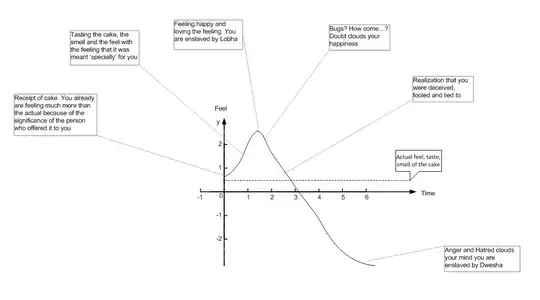
Everything above and below the dotted line which depict the actual taste, smell, feel of the cake are the effect of Moha. When Moha is not operating (at Arahath state) you would be able to feel the true taste of the cake. Nothing more, nothing less. Just the actual. This is why Arhath state is known as 'the awakened state'.
Does this mean most of the time we are perceiving more than we actually feel?
Yes of cause. Until one is Arhath, they will be a slave to Moha, which means they don't see the world as it is. They see their own perception of the world as interpreted through assigned values. This is the main reason for the endless wandering in Sansara.
So how can I guard myself against it?
Stop trying not to feel. That won't work. Try to see the reality of things through understanding of Dhamma. Being mindful and perceiving your thoughts is key. When you see the reality, as an effect of your effort to see things without any bias (without the effects of Moha), you will form less and less attachments, ultimately none - Arhath.
EDIT:
As a person who did not study Buddhism in English, my terminology could be different. So, I have put down some explanations on how certain terms should be taken.
- Feeling - What is felt by your senses
- Value assignment - Based on our habits and biases, and based on what we uphold as 'good for us', we constantly assign values to what we feel. Our actions are governed by the values we assign. If we take for an example; you have tickets to a musical show and on the same day at the same time you can attend a Dhamma discussion. You have to choose one from the other. Your choice of selection depends on how much you value each experience. (A simile to this is popular among native Americans: "There are two wolves in each person in constant battle. One is good; one is bad. Which one would win the battle?" - The answer is 'the one you feed the most'). Similarly the feelings you pursue define your actions.