2

Wikipedia says:

Some brandies have caramel colour and sugar added to simulate the appearance of barrel aging.

I wonder how one might know which ones do and do not have added sugar? Would buying only cognacs "imported from France" (in the US) guarantee that they don't have added sugar?

MWB
  • 450
  • 3
  • 12

3 Answers3

3

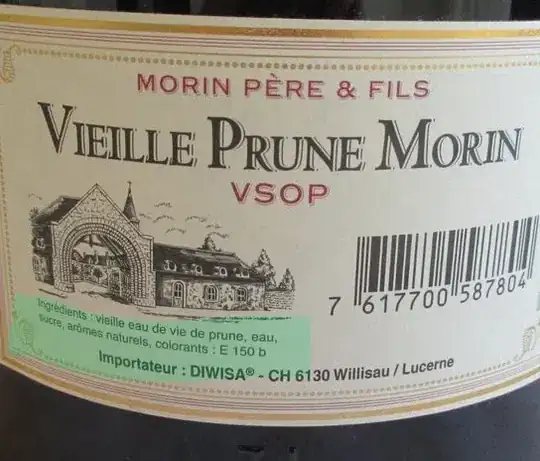
It says so on the label. EU regulations require for food additives to be displayed on the products label. Caramel, or E150, is a food coloring and is subject to this rule.

enter image description here

I'm not sure about Brandy from non-eu countries. There probably aren't such regulations.

d4zed
  • 1,257
  • 5
  • 14
  • I'm not sure that EU regulations apply to food/drink exported to the US. Probably not. – MWB Sep 22 '21 at 18:31
  • `Will the producers in the warehouse know where the bottling goes? Probably not` Of course, they need to know! https://www.law.cornell.edu/uscode/text/27/215 – MWB Sep 22 '21 at 22:51
0

No,

In France there are very specific rules to make Cognac (if you don't follow those rules you cant't call your drink cognac but just brandy). Those rules are about fermentation, distillation, ageing,... But, from what I know, there is no rules about adding colouring to the end product. Certain producers even add caramel colouring just for exportation because in certain countries (asians one for example) it is important to have a dark robe.

f222
  • 321
  • 2
  • 7
-1

Do cognacs "imported from France" have added sugar?

The short answer is possibly, if they employ certain food colourings.

It is not even possible that some French Cognacs may contain residual sugars.

Residual sugars

Residual sugars, as defined in the FDR, are sugars that are still present in beer after the fermentation process has been completed.

Seeing that cognac is a distilled liquor of 40% makes it very unlikely that the French would add sugar to their finished product. This would additionally alter the taste of the Real McCoy

All Cognac is brandy, but not all brandy can be considered Cognac.

For a brandy to be called Cognac, it must be made from specified grape varieties grown in the AOC (a majority of Ugni Blanc, with small portions of Colombard and Folle Blanche allowed), double-distilled in copper pot stills and aged at least two years in Limousin or Tronçais oak barrels. Cognac must be at least 40 percent alcohol.

The designations you see on Cognac labels—VS (Very Special), VSOP (Very Superior Old Pale) and XO (Extra Old)—are a guarantee of how long a Cognac has been aged. VS indicates that the Cognac has been aged at least two years, VSOP at least four years and XO (Extra Old) at least six years. Most Cognacs are aged much longer, however, featuring a blend of eaux de vie that can date back decades.

Coloring can legally be added to Cognacs to ensure consistency.

Ten Secrets About Cognac

Ken Graham
  • 10,587
  • 9
  • 36
  • 63
  • 1
    The question is not about residual sugar after destillation, but about "caramel colour and sugar added to simulate the appearance of barrel aging." which is a usual method when bottling barrel aged spirits such as whisky or brandy. – d4zed Sep 22 '21 at 22:10
  • 1
    Here https://www.cognac-expert.com/what-is-cognac-made-of/#coloring is a source that explicitly says sugar is used to color cognac – d4zed Sep 22 '21 at 22:34
  • @d4zed That should probably be the answer. – MWB Sep 22 '21 at 22:58