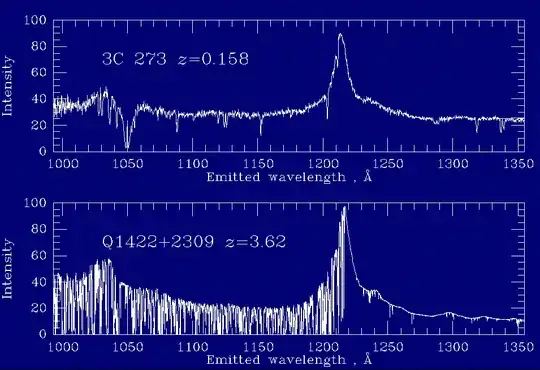
According to UCLA's web-tutorial Lyman Alpha Forest (Wright, 2004), there are many 'clouds' of gas between us and a distant quasar (as an example) that absorb
ultraviolet light at the wavelength of the Lyman alpha line of hydrogen at a wavelength of 122 nm.
However, as the clouds of gas have less of a redshift than that of the distant quasar, then their absorption lines are less redshifted than the distant object - a cartoon example is shown below (from the UCLA website):
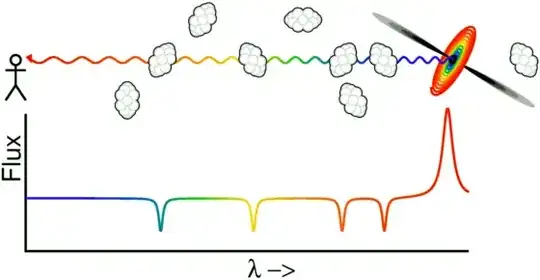
Now, the significance is of the forest is that it represents clouds that are smaller than the smallest galaxies, thus
We can only see these very low mass clouds by the absorption they produce in the strongest line of the most abundant element: Lyman alpha. Thus by studying the Lyman alpha forest we can learn about the density fluctuations in the Universe on the smallest observable scales.
A similar explanation of the significance of the forest, is given by Quasars, the Lyman Alpha Forest, and the Reionization of the Universe (Mortlock et al. 2011) is
quasars like ULAS J1120+0641 are bright and at high redshift, lower redshift intervening material can absorb some of their light, leaving fingerprints on the final spectrum that we observe on Earth. Because hydrogen is the most abundant element in the universe, it should come as no surprise that it leaves the most prominent spectral signature, in the form of a forest of absorption lines.
Specifically, of major significance is that Mortlock et al. (2011) state that
The Lyman alpha forest can be used to trace this re-ionization of the universe.