I have to imagine that the glow from the galaxy comes from the scattering and reflecting of all the collective starlight inside the galaxy off the dust and gas and whatnot contained therein, and that the actual individual stars would be kind of like individual droplets of water in a cloud.
This is not correct. The glow from from the galaxy is overwhelmingly light from individual stars traveling directly to us. This is demonstrated by the fact that galaxies lacking dust and gas, like most elliptical galaxies, have the same kind of "glow". (Examples: the compact blob of white light directly to the left of the center of Andromeda, about 1/4 of the image width away, is M32, a so-called "compact elliptical galaxy" in orbit about Andromeda. The more elongated, slightly more diffuse blob at 4 o'clock, about twice as far away from the center of Andromeda, is M110, a "dwarf elliptical galaxy" also orbiting the Andromeda galaxy. These are at roughly the same distance from us as Andromeda, but have essentially no gas or dust.)
What you are missing is the fact that the telescope optics (plus turbulence in the Earth's atmosphere for ground-based telescopes) blurs each individual star into a fuzzy disk with a finite size (each "disk" being bright in its center and fading away with increasing radius). These disks are large enough in angular size that -- if there are enough stars in a small enough area on the sky -- they overlap with each other, creating the appearance of a smooth glow.
You are correct that individual stars, even massive stars like R136a, are individually rather faint at the distance of the Andromeda galaxy; but there are hundreds of billions of stars in the Andromeda galaxy. Even in a small subsection of the galaxy, you are still seeing billions of stars. The combined, overlapping light traveling from those stars to the telescope is what we see.
Now, there are cases where you can see scattered/reflected light from dust, which has a lovely blue color (because dust scatters blue light more efficiently). But this is really faint, and generally only seen for nearby dust in our own galaxy. (Look for pictures of the Pleiades.) The faint blue regions in the outer parts of the Andromeda galaxy are not from this -- they are regions with lots of bright blue stars, due to there being lots of recent star formation in those parts of the galaxy. (Generally, only short-lived massive stars are hot enough to be visibly blue.)
In many galaxies, you can also see -- if you look at just the right wavelengths -- light emitted by individual gas ions/atoms/molecules in the interstellar medium. In the Andromeda picture you show, you can see faint pinkish blobs, mostly in the upper right of the galaxy; this is H-alpha emission from hydrogen atoms in ionized nebulae within the galaxy. This is somewhat exaggerated in the picture, because the person who took it deliberately combined the broad-band R, G, and B filters with separate exposures through a narrow-band filter centered on the H-alpha wavelength.
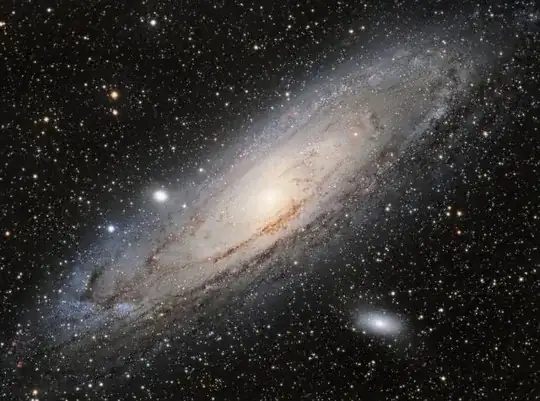 Image by André van der Hoeven


