The polar offset is not stable. Most researchers now think that the angle between the rotation axis and the magnetic field axis decreases with time. This is thanks to the same torquing mechanism which is slowing the pulsar down. The timescale on which this occurs is similar to the timescales on which pulsars lengthen their rotation periods to the point of switching off - i.e. of order 100,000 to a million years. Most of the (non-binary) pulsars that are observed are the remnants of a very recent supernova and there are probably a few hundred million "dead" pulsars in the Galaxy.
I guess if you mean stable on timescales of years, then yes they are stable. But over hundreds of thousands of years, they are not.
References:
Young et al. 2010
Philippov et al. 2014
Additional Details
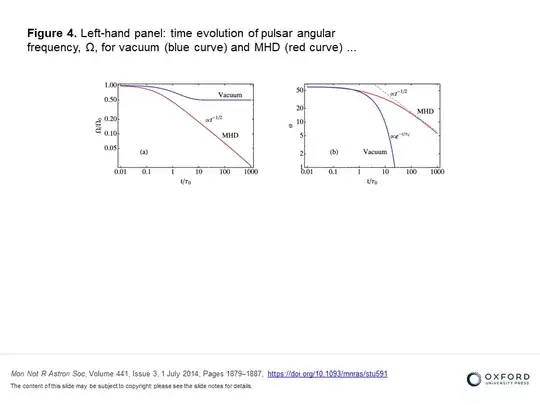
The picture below is from Philippov et al. (2014) and shows the time evolution of the rotation period of a pulsar and the the angle between magnetic and spin axes for a "vacuum" magnetosphere model and their favoured non-vacuum MHD magnetosphere - the time axis is in units of the initial pulsar spindown timescale.
Why is the timescale so "long"? Well, to align the two axes requires a very significant torque and change of angular momentum. As explained in Philippov et al. (2014), the alignment is caused by a component of the magnetospheric torque that acts upon the entire star, pulling the rotation and magnetic axes into alignment. The equation of motion for the angle of alignment $\alpha$ is
$$\frac{d\alpha}{dt} = - \frac{K_x}{I\Omega}\ ,$$
where $K_x$ is the component of magnetospheric torque in the same plane as the rotation and magnetic axes, but at right angles to the rotation axis and $I\Omega$ is the angular momentum of the neutron star.
Thus the instantaneous alignment timescale $\alpha/\dot{\alpha} \sim I\Omega/K_x$.
Since $K_x$ is just a component of the torque and $K_z$ (aligned with the rotation axis) is another, that causes the angular velocity to decrease on a timescale $I\Omega/K_z$, then the timescales for alignment and for pulsar spindown are of similar orders of magnitude (unless or until $\alpha$ becomes small, when the spindown torque vanishes).
That spindown (and alignment) timescales are long in terms of a number of pulsar rotations is because $1/\dot{P}$ is a large number (typically $10^{14}-10^{16}$ rotations) for neutron stars - they have very large angular momenta compared with the torques acting upon them.