4

Context: I want to simulate globular clusters in a simple way, just to display the positions of stars.

Assuming isotropy, what would be a reasonable model of the stellar number density as a function or r, the distance from the center of the cluster?

I'm assuming that such a model would have some free parameters as well.

John
  • 355
  • 1
  • 5

2 Answers2

4

The usual thing is a King model.

There are indeed free parameters. These are the central density, the "core radius" and a tidal truncation radius.

The background and rationale for these models is given in the link. They provide a pretty good representation of the surface density of globular clusters (or indeed open clusters). They require a numerical scheme to "deproject" from the plane of the sky to 3D.

If you find the nitty-gritty of Abel integrals too tricky in the deprojection, then you could always approximate with a Plummer model. This is analytically and computationally easier to deal with, but lacks a bit of physical realism. Central density and a characteristic radius are free parameters here.

ProfRob
  • 151,483
  • 9
  • 359
  • 566
4

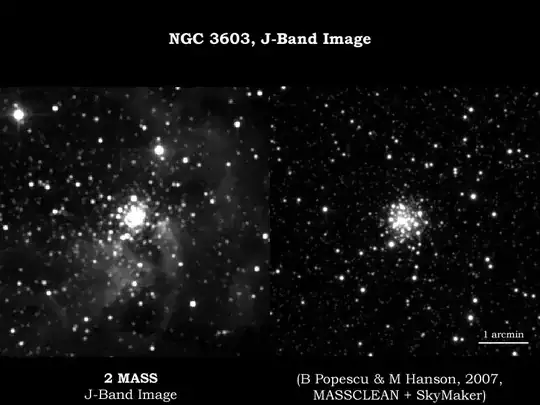
Check out the MASSCLEAN package, it can be used to generate artificial/synthetic clusters of arbitrary metallicities, ages, mass, radius (based on a King profile distribution) and even includes field stars contamination.

Here's an example of a cluster generated with the code (right) imitating a known cluster (NGC 3603, left):

enter image description here

See the original article for a good description of the capabilities of the code.

Gabriel
  • 822
  • 8
  • 18
  • 1
    That does look handy. How is the field star contamination handled? – ProfRob May 20 '15 at 20:06
  • 1
    It can generate an artificial one (based on the model presented in http://adsabs.harvard.edu/abs/1992ApJS...83..111W & http://adsabs.harvard.edu/abs/1994AJ....107..582C) or it can include a real stellar field. More details in Sect 2.5 of the original article. – Gabriel May 20 '15 at 20:12