A featureless spectrum and a spectrum low S/N are very similar.
Is there a way to tell the difference between them?
A featureless spectrum and a spectrum low S/N are very similar.
Is there a way to tell the difference between them?


Convert answer in comment to community wiki
You would need to do statistical tests. i.e. Is the data you have (given the known noise properties) consistent with a featureless spectrum? If not, then it has features. Of course, the lower the signal-to-noise or the weaker the features might be, then the harder it would be to rule out a featureless continuum.

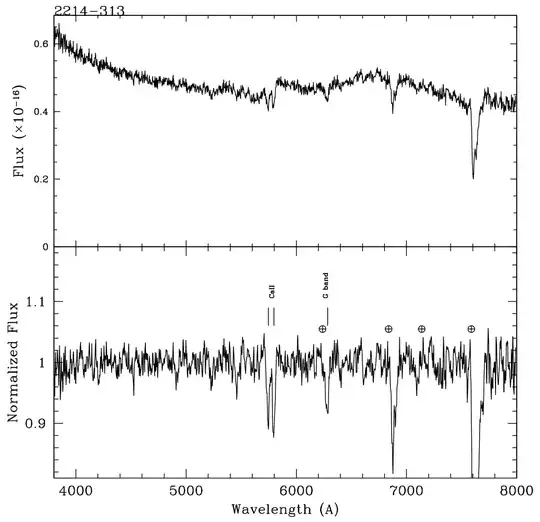
Both spectra you show clearly have real features. There are perturbations in the spectra at certain wavelengths that are far larger than the rms noise that can be assessed empirically (by eye, or calculation) from looking at other parts of the spectrum.
This would form that basis of an empirical test for the reality of spectral features. On the other hand, if your spectrum was full of (small) real features, then you would have to rely on a theoretical estimate of what the rms noise in your spectrum should be.
Either way, your questions as posed cannot really be answered in any detail. If you have a spectrum that is consistent with being featureless, there will be some amplitude of real feature below which it would be undetectable. This amplitude upper limit will increase as the signal-to-noise decreases - i.e. the better your data, the smaller the features you can rule out.
In the end, you can never be sure that you have a "featureless continuum", only that any features are smaller than some threshold, that must be established by calculation or simulation.
