 |
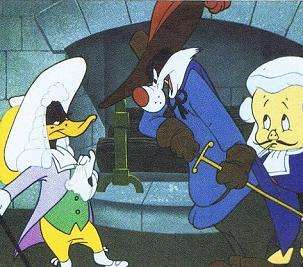
"Mayhap perchance, foppish that I am, I might be The Scarlet Pumpernickel?" —Daffy Duck, "The Scarlet Pumpernickel" |
 |
"The Scarlet Pumpernickel" is a 1950 Merrie Melodies short, directed by Chuck Jones and featuring Daffy Duck, Porky Pig, Sylvester the Cat, and "Melissa" (a female duck), with cameos by Elmer Fudd and the Mama Bear from Jones's Three Bears Trilogy. Purporting to be Daffy's own film concept (which he is attempting to pitch to "J.L."[1]), the short is a parody of a typical Swashbuckler -- including, of course, The Scarlet Pimpernel -- complete with Shout-Outs to Warners' own swashbuckling hero Errol Flynn and much Lampshading and Subversion of the conventions of the genre.
This short has been chosen number 31 of The 50 Greatest Cartoons ever made. It also made it onto The 100 Greatest Looney Tunes list.
- Anthropomorphic Shift: Sylvester, usually a Talking Animal, is fully anthropomorphic as the Grand Duke. Almost the complete opposite of Chuck Jones' other uses of Sylvester.
- Aristocrats Are Evil: The Lord High Chamberlain and the Grand Duke.
- Anachronism Stew: The setting seems to range anywhere from the late 15th Century (judging by Melissa's hennin) to the mid 20th Century (judging from the Lord High Chamberlain's bizarre hair dryer and Scarlet's use of a parachute), with perhaps some preference for about the 1680s or so.
- Antiquated Linguistics: As in the page quote, in which the "noble visitor" (Daffy) uses two separate archaicisms for "maybe," and the page image, wherein "the Grand Duke" (Sylvester) calls him "sirrah" -- a term of address for social inferiors in the 17th century or thereabouts.
- Aside Glance: From Daffy, as Milord High Chamberlain and the Grand Duke laugh at the idea of a Daffish Fop being The Scarlet Pumpernickel.
- Beard of Evil: Marks Porky as the evil Lord High Chamberlain. Apparently detachable.
- Black Comedy Rape: As when a tom-cat Funny Animal (Sylvester the Cat) is creeping up in prime Dastardly Whiplash style (complete with Evil Laugh) on a shrinking duck Damsel in Distress (Melissa the Duck).
- The Cameo: Lots of 'em. Henery Hawk is the LHC's messenger boy, Mama Bear is Melissa's lady in waiting, and Elmer Fudd is a lowly innkeeper.
- The Cavalry Arrives Late: "The cavalry rode to the rescue! ...but they were a little too late."
- Comedic Hero
- Duel to the Death: "Ha-ha! Ya ain't got a chance! I'm the hero of this picture, and you know what happens to the villain!"
- Flynning: As punctuated by the Gratuitous French "fencing terms"[2] the duellists employ, and the dramatic cast shadows typical of Michael Curtiz's Warner Bros. Swashbucklers.
- Fully-Dressed Cartoon Animal: The whole cast.
- Furry Confusion: The horses are never portrayed as anthropomorphic in any way, unfortunately.
- Gainax Ending: Losing his train of thought, Daffy gives his movie a convoluted ending, complete with a bursting dam, cavalry charge, erupting volcano, skyrocketing inflation of food prices, and the hero (and Daffy) shooting himself in the head.
- Girl in the Tower: The Lady Melissa
- Good Smoking, Evil Smoking: The Lord High Chamberlain's churchwarden pipe perhaps counts as "scene-setting smoking."
- The Highwayman: The Scarlet Pumpernickel's occupation.
- Land in the Saddle: Daffy misses the horse, causing him to muse that "this never happens to Errol Flynn".
- The second time, he uses a parachute: "Here's a wrinkle Errol never thought of!"
- Mood Whiplash: "Firtht, I am happy, for I am to marry the fair Meliththa! Then, I am furiouth, becauthe I dethpithe the Thcarlet P-p-pumpernickel!"
- Narration Echo: Daffy Duck narrates, "The Lord High Chamberlain was simply furious."
|
Lord High Chamberlain (Porky Pig): I'm simply furious! |
|
- Nothing Left to Do But Die: "There was nothing left for the Scarlet Pumpernickel to do but blow his brains out, which he does."
- Once Upon a Time: "Great opening, huh?"
- Pain-Powered Leap: Daffy scales the castle walls with the help of Ye Little Olympic Jumper - a pin to the hindquarters.
- Pen Name: Daffy "Dumass" Duck
- Puppy Dog Eyes: Used by Daffy to convince "J.L." to give him a dramatic part.
- Rogues Gallery Transplant: Sylvester and Daffy rarely ever even meet in most shorts, the former usually a foil to Tweety or Speedy Gozales, the latter to Bugs Bunny or Elmer Fudd.
- Sarcastic Confession: Provides the page quote.
- Secret Identity: The "weary young traveler" is, in reality, The Scarlet Pumpernickel.
- "Seen It All" Suicide: Though it is actually J.L. who has seen it all, and Daffy who commits the suicide.
|
It's getting so you have to kill yourself to sell a story nowadays. |
|
- And, as with all seen-it-all suicides (or any kind of suicide) on Looney Tunes, don't expect to see this on American TV uncut and uncensored. You're better off getting it uncut on video, DVD, or Internet.
- Actually subverted, since the bullet hole is in his hat afterwards.
- Shout-Out/To Shakespeare: Twice misquoted by Daffy -- "Vanity, thy name is woman!"[3] and "Parting is such sweet stuff."[4]
- Standard Snippet: Several, as is typical of a Carl Stalling score, including "Hooray for Hollywood" to set the scene at the studio; the Boccherini minuet to show that we are in The Cavalier Years; Ben Jonson's "Song: To Celia for the love scene; Suppé's Banditenstreiche during the chase scenes; and, of course, Richard Wagner's bridal chorus during the wedding.
- That Makes Me Feel Angry: The Grand Duke after getting the Lord High Chamberlain's letter. See Mood Whiplash above for the quote.
- The Other Darrin: A rare performance of Mel Blanc as Elmer Fudd.
- Wedding Smashers: The Scarlet Pumpernickel crashes Melissa and the Grand Duke's wedding and "saves" her.
- Yiddish as a Second Language: Notably invoked by both "Scarlet" and "The Grand Duke" -- "So what's to save?" and "So what's to know?", respectively. Also, when the price of food-stuffs skyrockets, the food-stuff illustrating the trend is Kreplach.