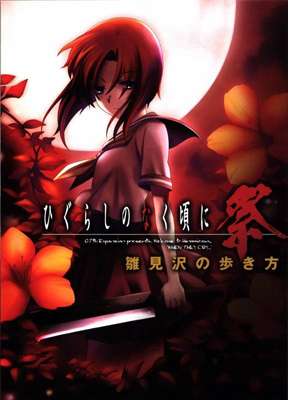
The year: 1983. When Keiichi Maebara and his family move to the sleepy little rural village of Hinamizawa, everything seems peaceful and rustic at first. But Keiichi quickly learns that there is more to the four girls of the school's game club than meets the eye... and more to the town as well. Revelation follows revelation, and brutal murder follows brutal murder in this enigmatic tale told from a variety of viewpoints and scenarios. Just what links the scenarios together?
The first four chapters of Higurashi no ku Koro ni focus on the cycles of paranoia and death that plague the main characters. The fifth to eighth chapters, Higurashi no ku Koro ni Kai, delves deeper into the causes of the repeating scenarios and their inevitable conclusions and the struggle to defy fate. The fandisc, Higurashi no ku Koro ni Rei, takes place as three sidestories after the main plot. A fourth, anime-only installment, Higurashi no ku Koro ni Kira is a series of light hearted Fan Service laden OVAs that are outside of continuity.
Higurashi consists of several different story arcs with most arcs beginning similarly but ending differently. If watched or read out of order, it can raise many questions about what is going on. See The Other Wiki's entry for Higurashi get the order the manga are supposed to be read in. The anime can be watched in order (episode one first), with Higurashi no ku Koro ni Kai being season two.
Part of the When They Cry series of visual novels by 07th Expansion, which also includes Umineko no Naku Koro ni.
Simplistic summaries of each arc are available on the When They Cry article.
- The Abridged Series: Higurashi Parody Fandub, among others.
- Absence of Evidence: Rena noticed that the bottle of shoyu in Rika and Satoko's house was missing, and deduced the possibility that they had visited the Sonozaki estate that night with an empty shoyu bottle and been kidnapped.
- Actor Allusion: In the first episode of Rei, this is combined with Expy and invoked in the form of Chie-sensei pulling out wooden T squares which look a lot like Black Keys.
- And again in the final episode of Rei, where one of Rena's cutaway fantasy scenes puts Miyo in the role of Sachiko Ogasawara.
- Adaptation Distillation: The manga does a great job at capturing the mood.
- Adaptation Dye Job: Eye variation. Keiichi's eyes are blue in the manga, sound novels, and Daybreak but purple in the anime and Mah-Jong game.
- The live action adaptation movies change everyone's hair colors to a "natural" color.
- Adults Are Useless: Subverted as an Aesop.
- An Aesop: A bunch, including: Stick by your friends no matter what terrible things they do, and you can fight fate (but if you screw up even slightly everyone you care about will probably die a horrible death anyway).
- Agent Mulder: Rena isn't the only one who believes in the the Hinamizawa god Oyashiro-sama, but she's definitely the most emphatic about it.
- All Just a Dream: ... Or Was It a Dream?
- The events were as real as all the other chapters. The protagonist was told it was a dream, which she didn't believe, in an attempt to assuage her guilt over her actions in it.
- Hanyuu thought to and told herself that the world was just a dream, nothing more.
- Also the
- The events were as real as all the other chapters. The protagonist was told it was a dream, which she didn't believe, in an attempt to assuage her guilt over her actions in it.
- All Men Are Perverts: Keiichi's argument to convince a pro player into throwing a baseball game. This includes bribery.
- Heck, during the same speech in the Visual Novel, he uses these exact words.
- He later gets an entire cult following simply based around the fact that he got them to admit that they were perverts.
- Pretty much all of the male characters are perverts, Satoshi and Akasaka aside.
- And the only reason for that is that they never get any screen time.
- Alphabetical Theme Naming:
- The Houjou kids are called Satoshi and Satoko.
- Miyo Takano and Professor Hifumi Takano. Hifumi can be written as 一二三 (123), while Miyo is written as 三四 (34), which continues the sequence. Would be a stretch, except that it's pointed out in the anime when the two characters first meet. In the Visual Novel, it practically beats you over the head with that. Numerous times it says that Hifumi (1-2-3) started counting, and Miyo (3-4) will keep counting afterwards.
- Alternate Continuity: Onisarashi-hen.
- Ambiguously Gay: Arguably, or not, Rika and Satoko.
- Rika, specifically, if her Almost Kiss with in the second season ending is any indication.
- It's almost funny how much Shmion Ship Tease there is in Meakashi-hen. Also, in the Japanese DVD release, they included an OFFICIAL ARTWORK poster of Mion and Shion fully naked and cuddling on the floor with lips almost touching.
- The anime is almost infamous for the amount of Twincest artwork they use, but still the Ship Tease is there in every version of the series, especially the manga.
- Ancient Conspiracy: Or maybe that's just what they want you to think.
- Animated Actors / Breaking the Fourth Wall: "Wrap parties". To elaborate, at the end of most arcs, the character's sprites get together and discuss the events of the story. After The Reveal they make one wonder if Ryuukushi 07 had the whole thing planned from the beginning, considering some of the things they say.
- The Anime of the Game
- Arc Words: Arguably, "Uso da!" ("Liar!"), considering its relevance to the theme and the fact that, whenever someone says it, the world is pretty much doomed.
- Similarly, "I'm sorry." If a character hears someone else say it, especially if they can't see the person who says it, then someone is either about to snap or, more likely, already has. Indeed, the poem at the beginning of Onikakushi-hen underlines the secondary theme through the series of atonement.
- Talk of or questions of belief also crop up a lot.
- Art Evolution: Between all three seasons of the anime. Also applies for the sound novels. It's justified in the remakes since it's a different art crew, but within the remakes the Playstation2 games different from the Nintendo DS ones.
- Asshole Victim: Several victims in certain arcs, such as Rina, who is shamelessly planning to swindle Rena's father for everything he's got.
- The Atoner: Keiichi in the appropriately-named Atonement chapter.
- Audio Adaptation: Before the anime and Matsuri we had a drama CD. Higurashi still few drama CDs coming out though.
- Axes At School: The end of the first season.
- Backstory: Characters' backstories remain the same in all scenarios, with one exception: Saikoroshi-hen.
- Backup Twin: The major cause of confusion about the ending of Watanagashi-hen.
- Beach Episode: Shyness-Exposing Chapter in the recently animated adaptation of Higurashi Rei (To be fair, that was more like a Public Pool Episode).
- Because Destiny Says So
- Berserk Button: If all the berserk buttons were on a berserk keyboard, then this series is the cat that falls asleep on that keyboard.[1]
- Beware the Nice Ones: Some of the perceived nice ones have faultier wiring than others. Though, granted, the less-nice ones go crazy at various points, too, so it's closer to Beware Everyone.
- Big Damn Heroes: Akasaka saving the day. Less seriously, Tomitake/Oishi/Irie (together with Keiichi, the "Heavenly Kings of Darkness") swooping in on surfboards in the middle of a pool scene to save Keiichi from having his swimsuit removed. Oishi ends up summoning a squad of fully-armed riot police to help, which storms in after their truck bursts through the pool fence.
- There's also one in Minagoroshi-hen with the club members, but it doesn't go as nicely.
- Big Screwed-Up Family: The Sonozaki family seems this way initially, but later arcs show that they're not quite as bad as they looked at first.
- Bishonen: Arguably Satoshi and Keiichi. They are both tall, slender, have delicate features, and big eyes; as well as being quite handsome.
- Keiichi has pulled off the "Bishie Sparkle" trick a few times. Notably in the first Picture Drama which came out before the anime.
- What about Irie? So what if he has a little bit of an obsession with Satoko? He's still pretty hot.
- Bittersweet Ending: The PlayStation 2 version's Miotsukushi-hen.
- The DS exclusive Kageboshi-hen.
- How about the ending to Matsuribayashi-hen?
- Blood-Splattered Innocents
- Bodyguard Betrayal: .
- Body Sushi: Shion in one of Keiichi's dream sequences from the first episode of Kira.
- Bonus Episode: Accompanying the first season DVDs was Nekogoroshi-hen (Cat Killing Chapter), a single episode scenario based on a light novel.
- Book Ends: Well, not exactly. The series is divided into chapters, with the first scene referencing back not to the final scene but the climactic scene of that chapter. (For instance, .
- Borrowed Catchphrase: Keiichi says "I want to take it home!" in Watangashi-hen part one (episode 5) to .
- Both Takano and say Nipah at one point.
- Bowdlerise: In the PlayStation 2 remake, all instances of red blood were censored into being dark colored or blue, due to CERO reclassifying its rating system, requiring the change to ensure the game got a D rating (17+ ) instead of a Z rating (18+ ).(In fact, the game was partially responsible for the creation of the Z rating.) The red blood was restored for the DS remakes.
- The scene that leads to the one where Satoko is different in the different adaptations. In the original sound novel, she's stark naked. In the remakes and manga, she has a towel on. In the anime, she has a towel on for most of the scene then goes and gets clothing, thus changing the way the scenes after it play out compared to the other adaptations. Manga Gamer, the company that releases the games translated, was going to put a towel on her due to Lolicon related reasons but in the end decided not to.
- Breaking the Fourth Wall: In Minagoroshi-hen, Mion and Keiichi break the fourth wall to explain some mahjongg stuff, and Rika says that Takano "lost them a lot of viewers" by not putting on a cat costume.
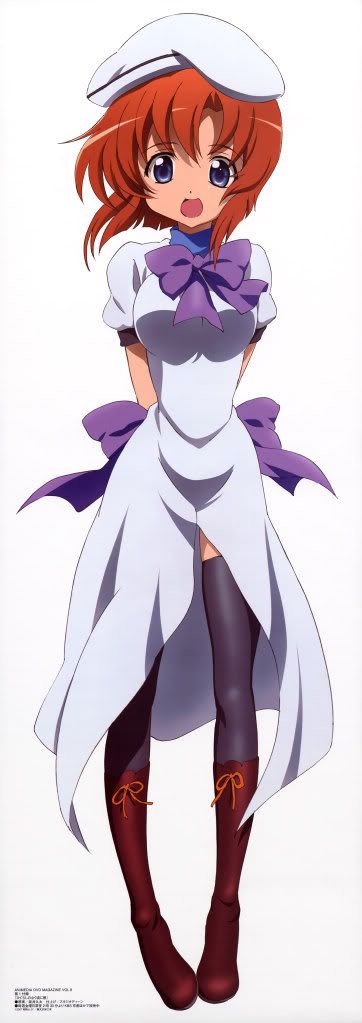
- Breakout Character: Rena
- Breakout Villain: Though not a villain for most of the series, is an iconic and often referenced antagonist character, making it on a lot of "top anime villain" lists too.
- Break the Cutie: They're really not picky about who they break, though
- Hell, they even break the Big Bad by showing us a damned flashback. Poor
- Bug Buzz
- Bullet Catch: Played for laughs in Hirukowashi. Mion decides to actually use her (BB) gun for once, on Rena too, but Rena catches the bullets.
- But You Were There and You and You: Delivered by at the end of the Higurashi Rei scenario Saikoroshi-Hen.
- Campbell Country: Hinamizawa is pretty much a Japanese version.
- Cash Cow Franchise: Higurashi, and the whole When They Cry franchise, is slowly becoming on of these. With the ever increasing fanbase in both Japan and the States, the manga, the anime and its OVAs, the drama CDs, and the overdose of merchandise.
- Casual Kink: The punishment game the kids play sometimes becomes kinky with the loser(s) having to submit to the winner(s) in a recognizable fetish way.
- Catch Phrase: "Hau hauu, omochi kaeri!", "Nipah~~!", "Kana, kana?"
- The last is lampshaded in the anime's Tsumihoroboshi-hen during the watergun fight, where her Evil Laugh is
- The Cavalry: Akasaka in the final Arc, and later the Banken.
- Charles Atlas Superpower: Lampshaded by Shion when Tomitake blocks a stun grenade with his chest in the pool episode in Rei.
- Clawing At Own Throat: A symptom of the Hinamizawa Syndrome
- Chekhov's Gun: Protagonist Mion constantly carries around a gun in a very visible holster, and,
- The gun was edited out of Mion's character art in the PlayStation 2 ports of the game.
- More so noticeable in the sound novels, where quite a number of her poses show it, and manga.
- Three very important ones are in the Cotton Drifting chapter. The whole "demon inside me" dialogue at face value is just complete BS'ing (she says it with face value intentions as well). However, if the viewer interprets it as a metaphor (not her intention), it's actually one of the biggest clues as to what's really going on. A borderline Fridge Brilliance grade example. The second important "gun"? Ooishi's findings about the body in the barrel. The third "gun" is what Rika says about those who enter the ritual shrine. Its a big hint about .
- The syringe in the Eye Opening Chapter. Namely the contents as revealed in the Festival Music Chapter. Major hint to the Hate Plague.
- Chekhov's Gunman: Akasaka, and boy does he pull the trigger.
- Chivalrous Pervert: Mion to Keiichi in an extremely rare female on male example. Much more prevelant in the manga. Being that this is Mion, she could also be screwing with Keiichi for amusement. Also threatens to ask what color underwear is.
- Cliff Hanger
- Clingy Jealous Girl: Arguably Shion.
- Cloudcuckoolander: Applies somewhat to Rena, as her thought process is often adorable but weird.
- later falls into this.
- Cold-Blooded Torture: Main reason why the Eye Opening chapter is so infamous. MO (mode of operation) for ion in said chapter and Cotton Drifting. Ironically, was also on the receiving end in one of the series' more infamous scenes (also shown in Eye Opening).
- Comatose Canary: Satoko in Yakusamashi-hen, and in Taraimawashi-hen.
- Compressed Adaptation
- Conspicuous CG: Don't tell me you didn't think that watermill stood out...
- Cooldown Hug: Didn't work the first time .
- It kinda worked in Tsumihoroboshi-hen, where the positions of the two character in question are switched. It only kinda worked because she had already cooled down for the most part by that point, or at the very least, is no longer insane.
- : As a subversion of Religion of Evil, this is what was really going on, and .
- Covert Pervert: In Rei Rena seems to have a bit of an attachment towards Keiichi's "Furry Seal".
- When Keiichi unintentionally flashes the girls, Mion is flustered, however the other three girls blatantly stare at it for a minute. Satoko even has a little smile by the end of it.
- Crap Saccharine World:
- Creepy Twins: Mion and Shion. The insanity in the first season doesn't hurt, either.
- Cryptic Conversation: Happens a lot in the first season.
- Crucified Hero Shot: Satako in episode 21. Justified
- Cold-Blooded Torture: See Nightmare Fuel.
- Curiosity Killed the Cast: Most strongly in Onikakushi-hen, but a few different arcs have aspects of this. Ironically, the Cat-Killing Chapter is a complete aversion.
- Darkest Hour: Yakusamashi-hen, where
- Deadly Doctor: Despite usually being is not harmless.
- Deadly Euphemism: When referring to
- Deadly Hug: Done in the ending of the Onisarashi-hen manga arc by
- Dead Man Writing
- Dead Person Conversation
- Decoy Protagonist: In that order.
- Despair Event Horizon: Keiichi is a Laughing Mad wreck in an insane asylum in the ending of , and all of the abuse he went through in in a scene that's Nightmare Fuel. In addition, when is found at the end of Taraimawashi-hen, or Satoko in Yakusamashi-hen, she's practically in a vegetative state. is stated to have suffered a Taraimawashi-esque breakdown at the end of of Someutsushi-hen.
- Diabolus Ex Machina: The alternate ending of Meakashi-hen, found in the DS remake. ()
- Did You Just Punch Out Cthulhu?: This is not a good thing.
- Disconnected by Death: Someone does die in a phone booth while trying to give the police information. Investigation showed it was suicide by clawing out one's own throat.
- Disney Villain Death: ion in the Cotton Drifiting and Eye Opening chapters.
- Distant Finale: Both subverted twice and played straight.
- The Dog Bites Back: ion to in the Cotton Drifting and Eye Opening chapters.
- Driven to Suicide: Happens a fews time in the series. Pre-series, tries to commit suicide by slashing her throat open (she slit her wrists in the anime though). Outside of the anime, instead of simply falling off of a roof, in Meakashi-Watangashi fell onto a roof but decided to fall off after rethinking what she had done. In the same arc, decides to drive a knife into her neck. In Yoigoshi-hen was driven to suicide by his overwhelming debt, but couldn't go through with it. The group he was with did.
- in the manga version of Tatarigoroshi-hen
- Drown The Dog: Just in case you had any doubts that Natsumi's grandmother had gone completely off the deep end when you see the paper charms in the front yard, once Natsumi goes into her house, she finds her grandmother drowning puppies in an effort to create a scapegoat onto which Oyashiro-sama's curse could be directed. Granted, this is right around the point where , so it may or may not be narrated accurately, but the omake at the end of the manga seems to suggest that it did indeed happen.
- Drowning My Sorrows: drinks wine despite being underage, as seen in the second season. A TIPS in the game confirms that she drinks to get drunk.
- Drunk on Bernkastel wine, no less, which is conveniently a real town known for its wines. (Unless, in a bizarre Shout-Out, the was named after the wine).
- Dummied Out: The English version of the sound novel has several songs, the Music Room, a mini-game, and the Staff Room cut out due to copyright issues.
- Dying as Yourself: At the very end of Meakashi-hen, has a moment of genuine regret and apologizes to everyone as she falls to her death.
- Dysfunction Junction: Everyone has a tragic backstory and/or psychological issues, even Detective Delicious. Satoko and Rika lost their parents (or more). Rena and especially Satoko have psychological issues related to their families; Shion's are related to losing someone she loved in a very torturous experience. There's a reason Keiichi's family had to move. Detective Ooishi lost a close partner and vows revenge. And so forth. Most of these characters reach Break the Cutie proportions.
- And what about Irie? It goes into more detail in the manga, but in short
- Early-Bird Cameo: in the third episode of Kai (her actual appearance to the viewers is in Minagoroshi-hen, and her first appearance to the cast, aside from Rika, is halfway through Matsuribayashi-hen) is heard talking to Rika off-screen, and later appears in the same episode as a silhouette behind Rena and Keiichi.
- She appears earlier, during the Atonement Chapter, in a manga omake.
- : Almost every individual arc has a bad ending.
- Eternal Recurrence
- Everybody Lives: Oddly enough, it's an example of Anyone Can Die, Kill'Em All and this one, the rare triple whammy! But only with the Matsuribayashi ending.
- Evil Costume Switch:
- Evil Laugh: Over and over and over again, complete with creepy face contortions.
- Evolving Credits: At first it seems that Rika waves at the viewer in the opening of Kai, but it turns out to be . A somewhat nightmarish shot of Hanyuu is added as well.
- Also, after the revelation that .
- Exactly What It Says on the Tin: The title roughly translates into When the evening-cicadas cry. Guess what sound you hear throughout the series.
- Also several of the arc names- most notably
- The series name also fits. "When They Cry". "When They Cry Higurashi" is more or less what "Higurashi No Naku Koro Ni" means.
- What's interesting is that it carries a double meaning in both languages Higurashi can be translated to "cicada" (蜩) or "day-to-day life" (日暮し), and Naku can mean to cry (as in call), cry (as in weep) or none/nothing. So the title from Japanese can be "When the Cicadias Cry" or "When the day-to-day life is no more". In English "cry" still carries two meanings, to weep or to call.
- Expy: Chie-sensei, of Ciel-senpai in Tsukihime, with permission from Type-Moon. This is lampshaded in the Pool Episode with Chie whipping out imitation Black Keys in the form of wooden T-squares. In fact, this is one of her weapons in the doujin game Higurashi Daybreak, and she can be selected as wearing Ciel's outfit.
- Keichi in the animated version looks just like Kira of Gundam Seed, having a similar hairstyle, same purple eyes, and even the SAME voice actor!
- Satoko looks like Stella from Gundam Seed Destiny.
- In one of the cast review sessions, Chei-sensei was acting like Ciel-senpai when the lights were off and no one could see the copyright infringement.
- Eyes of Gold: Takano, at the very least in the early episodes.
- They're more so brown in the sound novels, and later episodes.
- Droopy-tan.
- The Faceless: The appearanced of Keiichi's parents aren't shown in the novels at all, and in the anime we just get their faces from the mouth down. The manga do show their entire faces, but they conflict with what little we see in the anime; for example, nothing is really notable about the bottom half of Mr. Maebara's face in the anime, but in the manga, he's got a beret and a Frenchy goatee. And is in much better shape.
- Plus their voices and personalities don't seem to match.
- Face Death with Dignity: .
- Not to mention in the end of Minagoroshi, though slightly less "dignity" and more "laughing in your murderer's face about how her plan is stupid and she's stupid". .
- Faking the Dead: .
- False Crucible: Dr. Koizumi .
- Fan Girl: Rena goes nuts over anything she thinks is cute, squealing and announcing her intention to take said object of her affection home. In the second season, the perpetually-stoned Takano reveals her terrifying fangirl side over the dark legends of Oyashiro-sama).
- Takano's fangirl side also has a less than dignified side.
- Fan Nickname
- Kuraudo Ooishi to "Detective Delicious" for his name's similarity to oishii ("delicious").
- Mion and Shion Sonozaki to a collective "Shmion" for being Creepy Twins and pulling off Twin Switches, .
- Shion's other nick name is That psycho Yandere chick who tortures everyone.
- Miyo Takano to "Droopy-tan" for her perpetually stoned appearance.
- Keiichi Maebara to "K1" for the kanji of his name, which contains the number 1.
- Rena Ryuuguu to "Cleaver Girl" for her iconic Weapon of Choice.
- There's a small group of fans who refer to Tomitake as Tommy Tucker as the pronunciation sounds similar to the Little Tommy Tucker nursery rhyme.
- Fan Service with a Smile: Shion's work uniform at the Angel Mort Cafe. There's official art with all the other girls wearing it, too.
- Fantastic Aesop: Defied in the last chapter of the OVA-only Dice-killing chapter. When Rika is angsting because she and then goes off to deliver a different, valid Aesop about how the multiple tragedies they faced have made them better people.
- Festival Episode (repeatedly)
- A Fete Worse Than Death: You know that cheerful summertime festival these townspeople have? Well, it wasn't always cotton that they tore up...
- Doubles as Fridge Horror very much when you consider that
- Finger-Lickin' Evil
- Finger-Twitching Revival
- Fingore: This is common. And also, the opening song has a line that translates roughly as "I'll cut off your fingers and leave them in the forest."
- Five-Man Band: This series is slightly unusual in that some characters tend to move around.
- The Hero: Keiichi
- The Lancer: Rena
- The Big Guy: Mion
- The Smart Guy: Satoko, eventually Rena.
- The Chick: Rika
- Sixth Ranger: Shion and eventually,
- Flashback Twist: In one of the latter arcs, the famous Tsumihoroboshi-hen or Atonement Chapter, it is revealed in Keiichi's flashbacks that
- : The catalyst for many unpleasant things.
- For Want of a Nail: Arguably, the doll in the Watanagashi-hen and Meakashi-hen arcs. In fact, this trope was the point of the parallel arc system used.
- Freak-Out: Often. Shion goes through layers of them.
- A Friend in Need: The origins of the game club were as
- The Gadfly: Played for laughs with Mion who gets plenty of amusement from yanking Keiichi's chain. Posssibly motivated by how bad she is at expressing her true feeilings for him. Also her punishment games.
- Gag Dub: The somewhat infamous Casey & Friends.
- Gaiden Game: Higurashi Dayreak, a game done in the style of the Gundam vs. Series, specifically Alliance vs. Z.A.F.T.
- Gainaxing: Shion, but for only one scene in the second season.
- Yeah, but there's a GIF of it.
- Also, Mion in the first season OVA (Nekogoroshi-hen).
- Kira seems to be fond of it.
- Gas Chamber: .
- Gas Leak Coverup: See above.
- Generation Xerox: In the manga Keiichi looks similar to his father and shares his Hot-Blooded tendencies. The twins mother and grandmother share similarly goofy personalities and In looks only, Rena resembles her mother and apparently has some of her fathers personality. Satoko and Satoshi both resemble their mother in the manga. Rika both looks like her mother and .
- Genre Shift: More like Genre Roulette! Between Slice of Life Comedy, Drama, Horror, and Action-Adventure, to name a few. A good rule of thumb is to note what happen when a heavy object hits someone's head. If huge amounts of blood splash out of the head, it is horror. If the victim starts hilariously yelling, it is comedy. If it's bleeding a bit, and needs a bandage, it is drama, if he faints without bleeding, it is action-adventure.
- Ghibli Hills
- Glurge Addict
- A God Am I:
- Especially dramatic when you contrast this with the character of the
- Gold Digger: Rina Mamiya. And how.
- Gondor Calls for Aid: Done spectacularly in the arc.
- Good Eyes, Evil Eyes: Consider for a moment the difference between the main characters' eyes and . Also, this one may be at work on at various points. When , for instance, goes insane, her eyes just go blank, and when does, his pupils shrink, whereas a lot of times when has an episode, her eyes narrow to an almost grotesque degree.
- Grotesque Cute
- : One of the major components of the show's premise.
- Except it's not really a it's
- Guess Who I'm Marrying: Almost happens to .
- Guide Dang It: Getting One Hundred Percent Completion in Kizuna without a guide is virtually impossible, due to all the hidden choices, scenes, and CGs that the game only vaguely hints at.
- : The other major component of the show's premise.
- Hellish Pupils: The "cat eyes" in Onikakushi, as well as about ten other different types of iris contortions.
- In the manga, and sound novels, their eyes are often (different artists draw it differently) a mix between "depressed" eyes, and glowing eyes.
- Amusingly, the girls also get the glowing eyes and ominous lighting when they're about to inflict some humiliating-but-funny "punishment game" on Keiichi.
- In Episode 15 of Kai,
- In the manga, and sound novels, their eyes are often (different artists draw it differently) a mix between "depressed" eyes, and glowing eyes.
- Hidden Eyes: Common among the main cast.
- Hime Cut: Rika.
- Hollywood Atheist: .
- Which is ironic, since she is the only one of two characters to meet a god and actually recognize it.
- Hope Spot:
- The Hyena
- Hot Mom: Akane Sonozaki, Shion & Mion's mom. Her Daybreak Mega Edition ending is even fanservice with her in an Angel Mort uniform. To be honest actually... the manga's interpretation of Keiichi's mom, and Rena's mom in all medias, is this trope.
- The newest sound novel shows us Unsurprisingly she was this.
- Rika's mom too!
- Hell yes.
- How Dare You Die on Me!: Played straight multiple times. Inverted with . See Please Don't Leave Me below.
- Hyper Awareness: Rena. She figures out exactly how Satoko and Rika got kidnapped because there was an empty bottle of soy sauce on their table, for crying out loud.
- In the game, the empty bottle is stashed away. She still figures it out based on that and their dinner for the day being in the fridge.
- It's implied and then eventually confirmed that she's
- In the game, the empty bottle is stashed away. She still figures it out based on that and their dinner for the day being in the fridge.
- Identification by Dental Records
- Idiot Ball: Often carried by Keiichi, as at the end of the second arc when he knows one of his friends is crazy and out to kill him, and the cops have warned him to look out if he ever sees her again... then he just walks outside and chats with her when she's standing creepily outside his house.
- In the anime at the end of second arc, he goes into a creepy dungeon filled with torture implements with a murderer AFTER she explains to him that she murdered a bunch of people, including two kids. Thats Darwin Awards material.
- Justified mostly: the characters are often aware of what they're doing, but choose to ignore the stupidity of it and proceed anyway, out of friendship, pride, revenge or so on.
- "I Know You're in There Somewhere" Fight: Between and in the end of the first season.
- I Know You Know I Know: The club games, and Satoko's traps.
- I'm Taking Her Home with Me: Trope Namer, uttered by Rena whenever she sees something cute.
- She says this and then proceeds to kidnap Hanyuu three times, and thats within a three minute span.
- Improvised Weapon: Weapon options in Higurashi Daybreak.
- Inane Blabbering
- Insane Equals Violent: Oh heck, let me list the ways...
- Infant Immortality: Brutally averted, over and over again, in the most horrible manner possible.
- Intertwined Fingers: Hanyuu and Rika do this in the ending credits of Kai.
- There's a lot of Shmion pictures that involve this.
- In the Blood: Remember how Well, the TIPS reveal that
- Also, the belief of some people (apparently including ) that the people of Hinamizawa are descended from man-eating demons.
- A later tip shows near the end of Matsuribayashi
- Also, the belief of some people (apparently including ) that the people of Hinamizawa are descended from man-eating demons.
- It Makes Sense in Context: Episode 1 of Rei

- The anime had a habit of opening each new Arc with a random scene from later in the arc (or from a different one entirely). Such as the Cotton Drifting Arc, which starts with . Then the theme song plays, then they cut to the funny few minutes before the murders start.
- It's for a Book: Keichi while planning the perfect murder. Later Rika uses this to find out who's .
- Rika's a lot more subtle about it.
- I Wished You Were Dead: To a near-superpower extent in one arc.
- Though we find out later that
- The Jailbait Wait: Doctor Irie and Satoko.
- Jumping Off the Slippery Slope: Almost every arc starts with something minor or forgivable that gets worse and worse until...
- Just in Time: Happens twice,
- Karma Houdini: , who were behind supposed Big Bad and were driving them on when they wavered, apparently get away without anything more than the failure of their power play, presumably by making their scapegoat for everything. This despite almost EVERYTHING being their fault and them having NO Freudian Excuse.
- The last episode of Kai hints that the scapegoat plan might fail
- Karmic Death: Frequently.
- Kick the Son of a Bitch: ion killing in the Cotton Drifting and Eye Opening chapter. And any time anyone decides to murder Teppei Houjo.
- Kill'Em All: The Tatarigoroshi chapter truly does Kill 'Em All - .
- Killed Mid-Sentence:
- Kill the Cutie: There's a reason it's part of the horror genre.
- Knight Templar Big Brother: Keiichi, towards Satako. The last one is quite possibly motivated by . Deconstructed since everytime it occurs, tragedy strikes or nearly does so.
- Large Ham: Dr. Irie gets some of this. Not to mention Keiichi when masquerading as Kei-kun.
- Laughing Mad: Rena and Shion get to this point pretty quickly when it's their turns to snap.
- Laugh with Me: One of the rare moments when this trope is Played for Drama. See the above entry.
- Laxative Prank: In the Cotton Drifting arc, Satoko uses this as part of an elaborate prank against some punks who are trying to take advantage of Shmion during the Angel Mort dessert fest.
- Lecherous Licking: Occurs in Kira when Shion is licking cream off of Mion who is doing a Body Sushi as a punishment game.
- Let's Get Dangerous:
- Lighter and Softer: Dear Lord, going by the trailer, the only thing people will be dying from is Diabetes from the show!
- Take into consideration that Kira can be translated as Sparkle and this becomes even more obvious.
- Just compare the first opening with Kira's (warning: extreme Mood Whiplash)
- Take into consideration that Kira can be translated as Sparkle and this becomes even more obvious.
- Live Action Adaptation: The films Shrill Cries of Summer (Higurashi no Naku Koro ni) and Shrill Cries: Reshuffle (Higurashi no Naku Koro ni Chikai).
- Lolicon: Dr. Irie, for Satoko. Not taken seriously.
- Loser Son of Loser Dad:
- Losing the Team Spirit: during the penultimate arc of the second series.
- Lost Aesop: Killing is bad! Don't ever kill people, because it is a horrible thing that will scar your soul and make you go insane. But fighting a whole army using Kalashnikovs, huge falling lumbers, and the same baseball bat that used to smash people's head with a single blow? It's perfectly OK in case your story suddenly turned into an action-adventure where mooks suddenly can't die just fall unconscious.
- Lover Tug of War: Shion and Mion to Keiichi. Takano and Tomitake to Rena.
- Love Triangle: Keiichi and the twins. Oh yes. In later arcs and Higurashi Daybreak, Shion is replaced by Rena.
- The Love Triangle between Keiichi, Mion, and Rena is hinted as early as Watanagashi-hen in the "doll incident." Ironically,
- In the Meakashi-hen manga
- Lyrical Dissonance: Shion and Mion's Image Song, Futari no Birthday, is an incredibly upbeat pop number with incredibly depressing lyrics. Get some of that action here.
- Similarly, Hanyuu's Image Song, Nanodesu. Fantastically upbeat, cheerful, and fun song, with lyrics that boil down to "I'm powerless, I can't do anything".
- Higurashi character songs seem to be full of this. Rika has two image songs one for her childish, cheery voice and other for . Ironically, the former's lyrics are depressing, while the latter's are more hopeful.
- Mad Doctor: A TIPS in the games notes that performed psychosurgery on unwilling subjects in the past, and a flashback in the final season of the anime . is a little bit more literally one.
- The manga adaptation of Matsuribayashi takes this further
- eagerly planned and prepared the days before it would happen in the Visual Novel.
- The manga adaptation of Matsuribayashi takes this further
- Mad Scientist's Beautiful Daughter: Inverted. .
- Mafia Princess: Mion, although technically she's a yakuza princess.
- : Rika and Satoko are this in Episode 2 of Kira.
- The Men in Black: Beware the Janitors, for they are Anonymous, and they are Legion!
- Meaningful Name: Probably accidental, but "Rena" could be short for the Spanish word "renacimiento", meaning "rebirth".
- Media Watchdogs: PEGI was obviously sleeping when it gave the French translation 7+ rating.
- ... my God, it's true!
- Milkman Conspiracy: The mastermind behind everything is ?
- Mind Screw: In general the whole air of mystery and paranoia (both of which are cleared up in the second season). A specific example -
- The whole idea behind the series is this, to the point where the last episode gives you a slight clue of what the hell is happening.
- Mood Whiplash: Not just the anime itself, but even some of the character image songs get in on this, particularly Rena's.
- One of the TIPS in the visual novel, Weekly featured article, goes from a gruesome murder article to an advertisement for a lucky charm (even the music goes from creepy to comical).
- Mukokuseki: God damn but nobody in Hinamizawa looks Japanese. Case in point, the Sonozaki twins' green hair? If mom is anything to go by that's genetic. Ditto the Houjous, who seem to have naturally straw blond hair.
- And the Furude family. Father: black hair, Mother: dark bluish purple hair, Rika: same as Mother, and . Not to mention Rena (light auburn) and Rina (bubblegum pink).
- Multiple Reference Pun: The title. The "naku" means "to cry" as in both weeping and an animal making noises. Higurashi is a type of cicada, but can also mean "everyday life"; the entire title can be translated as "when there is no everyday life."
- It also applies to the English title with the multiple meanings of "cry".
- Miyo theorizes this applies to the name of Watanagashi festival; Wata means cotton and
- Must Make Amends: Subverted when kills in the underground torture chamber; she believes at first that she's helping her . Then she tries to talk to his shadow that has appeared on the wall (she's gone nuts at this point obviously), when she realizes the last words of him were: She literally pisses in her pants at the realization, but realizes she's already crossed the Moral Event Horizon and then goes off to brutally murder more people.
- My God, What Have I Done?: Numerous instances. Keiichi gets one after , Rena at the end of Tsumihoroboshi-hen, and Shion gets one for all of ten seconds when , and then goes on to merrily add two more bodies to her pile.
- She gets another 5 seconds
- In the manga and sound novels it's played more straight.
- She gets another 5 seconds
- My Greatest Failure: The manga adaptation of the Festival Music chapter reveals Mion's reason for not wanting to talk about Satoshi's disappearance.
- BestFriends: " Your best friends! You have to talk to yourbest friends"
- Never Mess with Granny: Oryou Sonozaki, or Oni-baba, devil granny, to Mion and Shion.
- New Transfer Student: Keiichi .
- Nightmare Fetishist: Takano Miyo. Loves the horrifying legends about Hinamizawa and is fascinated by the actual ancient torture equipment.
- Noblewoman's Laugh: Satoko does this a lot, and always does after pulling off a prank.
- No Ending: The manga-only Utsutsukowashi-hen, which was cancelled after the first volume.
- Nosebleed: Rena gets this after imagining ripping off Keiichi's swimsuit in Higurashi Rei. "Keiichi's furry seal... I want to take it home!"
- Keiichi also gets one in the last episode of Rei,
- Rena gets these often.
- ESPECIALLY in the Visual Novel.
- Not Quite the Right Thing: If Akasaka finishes helping out in the kidnapping case in Hinamizawa, , something he is able to prevent if he heeds Rika's warning. In addition, arguably Keiichi giving the doll he wins to Rena, as what seems like a kind act .
- Unless after watching the latter you come to the conclusion that that was a bold-faced lie and the doll had nothing to do with the murders, and the claim was just another way to .
- It's not so much a lie as it is a more...indirect influence. For Want of a Nail indeed.
- Actually, Akasaka going home mid-case isn't what saves her, mainly because he never did that. By calling home on the first night he forgot to do so and telling her to be very careful, he saves her life. In the Visual Novel for Matsuribayashi, Okonogi was the one who fought Akasaka back with the kidnapping of the minister's grandson. If Akasaka had to rush home to save his wife, the conversation between him and Okonogi in his Big Damn Heroes moment wouldn't make sense.
- Unless after watching the latter you come to the conclusion that that was a bold-faced lie and the doll had nothing to do with the murders, and the claim was just another way to .
- Off-Model: The first season is infamous for this. Doesn't help that this came to a head during what should've been a in the finale (you know, the episode where most series are guaranteed an Animation Bump?).
- In episode 17 Rika spends an entire scene with Shmion's hair color.
- Season two and the OVAs fix all of the problems with gusto.
- Off to Boarding School: Shion, as seen in her flashback arc. Her first appearance has her return to Hinamizawa after breaking out.
- Older Than They Look:
- Once Is Not Enough: In Onikakushi-hen, Keiichi shoves Rena to the ground and runs, only to be beaten down by the Almighty Janitors and be unpleasantly awakened by guess who.
- One Hundred Percent Completion: In Kizuna, the DS adaptation, in each volume, after you finish the arcs, you can go back to complete the situation tree and get alternate endings, as well as unlocking CG pictures and music.
- Only Sane Man: , despite her violent heritage, is the only club member to during the course of the series.
- Orphanage of Fear: is trapped in the orphanage from hell in . The manga cranks it up several thousand notches.
- Our Hero Is Dead: Almost every arc, actually, but notably at the end of Onikakushi-hen.
- A better example would be more like, Our is dead,
- Out of Continues
- Painting the Fourth Wall: Okonogi in Rei during the pool episode.
- Panty Fighter: Higurashi Daybreak
- Parental Abandonment: Satoko's parents are dead, and her sometimes-appearing uncle is an abusive alcoholic. Rika doesn't have any surviving family; the two live together by themselves. Rena's mother ran off with another guy. Shmion's mother is on bad terms with their Yakuza family and seldom shows up, while their father makes one appearance in the second season.
- Playing with Syringes: The major irony with this trope being that
- Please Don't Leave Me: is only source of comfort and friendship. If she
- Poor Communication Kills: The events of as a whole and the last third of are a result of this.
- Subverted in : A long series of misunderstandings almost kills, but is averted at the last minute. In the Visual Novel, there are even more misunderstandings before it is averted.
- Power of Friendship: If there was ever a show to which the saying "Friends help you move, best friends help you move bodies" applied, it's this one.
- The Power of Trust: At least as important to the solution as the Power of Friendship, if not more.
- Present Day Past: The series is set in the earlier 1980s yet there are a couple things that really shouldn't be back there. The Sound novel seems to like invoking this trope for the lulz. In the Watanagashi Arc, the gang is playing the game Sympathy. (In which someone says a word and each player must write down what first come to mind. A player receives points by having the same answer as another player.) When the word is sakura (cherry blossom) Keiichi tries thinking like a girl in order to gain the lead. His answer? Cardcaptor Sakura.
- Not to mention that by looking at the counter on the game shop in the Watanagashi Arc, Yu-Gi-Oh! and Duel Masters packs can be clearly seen.
- The anime gets in on this action too. In the OVA, the Cat-Killing Arc, Satoko is seemingly dressed up as Shampoo.
- In Meakashi Arc, Keiichi talks about end of Cold War- In a lecture about porn.
- In Tsumihoroboshi Arc, someone offers a Higurashi beta for exchange of Angel Mort event ticket - 20 years early.
- A Higurashi beta? In the world Higurashi takes place in? Huh? I guess it's like when Akasaka made a book similar to the series based off the events of an arc
- That doll Keiichi gives everybody in one or two arcs really does resemble a Rozen Maiden.
- In Minagoroshi, Keiichi mentions numerous videogames that have not existed yet when he tries to convince Komura (The baseball player) to help rescue Satoko. Some of the games he mentions are Resident Evil (1996), Metal Gear (1987), A new "Dead or Alive" coming out (The first one came out in 1996, the second one was 2000)
- The thin-rimmed glasses worn by Dr. Irie are of a design that didn't get common before the mid-nineties. Early-eighties glasses were quite much uglier by today's standards (The circular frames he wears in the manga are a little closer to accurate than what appears in the anime).
- Prolonged Prologue: Matsuribayashi, which is especially Egregious because the previous chapter actually managed to end on a pretty epic cliffhanger.
- Promotion to Opening Titles: Hanyuu. Also,. A variation occours with who is featured much more prominently in the credits of the second season, as they have run out of Decoy Protagonists.
- Don't forget Keiichi, who, for some reason, didn't appear in the first season's opening despite being the protagonist for 4 of the 6 arcs in it.
- Promotion to Parent: Satoko's brother Satoshi, until he 'transferred out'. Now, Rika and Satoko live alone without guardians.
- Pun-Based Title: Hirukowashi-hen is named after Higurashi Daybreak, but "hirukowashi" means "day-breaking" (like breaking a day into a million pieces, not dawn).
- Quivering Eyes
- R-Rated Opening
- The Rashomon: Watanagashi-hen, as with most of the early arcs, is told from Keiichi's point of view. Meakashi-hen revisits this arc from the perspective of Shion.
- Sometimes overlaps with The Killer in Me.
- Razor Apples: Rena sticks a needle in the ohagi she gives to Keiichi.
-
- Really Seven Hundred Years Old: Hanyuu , thanks to the Groundhog Day Loop effect. Unlike Hanyuu and most other examples, the latter's maturity matches her actual age, though this is deliberately hidden so as to not freak people out.
- Real Place Background: Hinamizawa is based off, as in an exact copy, of Shirakawa-go. Semi Justified being that the original novels used photos for the backgrounds.
- Recurring Riff: Dear You and all of the variations thereof in both Image Songs and background music.
- Red Eyes, Take Warning: The red eyes should be your first clue that is up to no good.
- Red Herring: Two of them actually, and very well done. Both of them however, are major contributing factors to the Hate Plague when pursured
- 1.
- 2.
- Refusal of the Call: In the Playstation 2 game, if you don't have Keiichi enter any other arcs through their triggers, you end up in Taraimawashi-hen, which basically flogs you for doing this. .
- Religious Horror: The origins of the Cotton-Drifting Festival.
- Retirony:
- In point of fact, though, Ooishi probably dies fewer times than anyone else in the main cast--he's almost always there at the end to make futile attempts to put together what happened.
- Rich Bitch: Rina Mamiya
- Roaring Rampage of Revenge: Meakashi-hen is this combined with Jumping Off the Slippery Slope.
- Romantic Two-Girl Friendship: Rika and Satoko. Later Rika and Hanyuu too.
- Rooftop Confrontation: Keiichi and Rena's fight on the roof of the school. Probably the iconic scene of Tsumihoroboshi-hen.
- Rope Bridge: The bridge that Keiichi chases Satoko over . In Yakusamashi-hen, this trope is used slightly more traditionally. .
- Sanity Slippage: All over the damn place.
- Saying Sound Effects Out Loud: Rika will sometimes say "pachi pachi" (the Japanese onomatopoeia for clapping) to emphasize her own clapping. Similarly, she says the Unsound Effect "Nii-pah~!" when she grins.
- Screw Destiny: Theme of the second season. incredible powers of persuasion and determination to destroy fate -- combined with a sequence of minor miracles -- revive her own will to fight against destiny and give both her and Hanyuu the courage to face their fears.
- Self-Made Orphan:
- In Rei, it's mentioned in passing that .
- Series Mascot: Rena. Quite easy to notice.
- Serial Escalation: "Thank you very much for playing 'Higurashi When They Cry --Meakashi--'. Thanks to your support, I could bring the fifth episode to you. 'Higurashi' will increase its intensity toward the ending."
- Serial Killer: ion in the Cotton Drifting and Eye Opening chapters (the killings are over a period of days as opposed to a rapid burst of kills). The combination of various traumas and results in the Visionary type and Revenge sub type.
- Serious Business: The club's assorted games usually end up involving Hot Bloodedness, blackmail, and/or shameless cheating.
- In the mahjong game for PSP and Arcade, winning or losing a game of mahjong is a matter of life and death in Oyashiro-mode.
- Set Right What Once Went Wrong: .
- Shoo Out the Clowns: Any given arc generally gets serious (and scary) after the shrine festival. Until then it's usually a chance to show the characters at their cutest.
- Shout-Out: To Studio Deen's own Mariasama ga Miteru franchise in Rei.
- The sound novels have a few as well. During Onikakushi-hen, Keiichi gives a Rousing Speech with referances to both Mobile Suit Gundam and Space Battleship Yamato.
- Either a translation error or a Shout-Out to translation error by Mangagamer:
- In the final episode of Rei, one of the mahjong books found in Rena's VW Van is about Washizu mahjong
- Ever wonder if Rika's Verbal Tic, Nipah! has any meaning? Ever heard of the Nipah Virus?
- Shrines and Temples
- Shut Up, Kirk: shoots point blank during his Kirk Summation to shut him up.
- Sibling Yin-Yang: Mion and Shion contrast each other, and Irie mentions that before Satoshi "transferred," he and Satoko also had those tendencies.
- Smite Me Oh Mighty Smiter: In a flashback arc, the villain challenges God to kill them or save them. 'God' then misses with its subsequent lightning bolt, instead vaporizing the neighboring tree and apparently losing the bet.
- The same situation is inverted later in the same arc, when A shame so many people mistook it for a Deus Ex Machina.
- Actually, in the game,
- The same situation is inverted later in the same arc, when A shame so many people mistook it for a Deus Ex Machina.
- Solemn Ending Theme: "Why Or Why not".
- So What Do We Do Now?: Twisted in Saikoroshi-hen, a bonus chapter for the game that takes place after the main storyline, where one character wakes up in a perfect world without any of the tragic backstories or danger from the previous worlds .
- Split Personality: Arguably and Frederica Bernkastel. One of the less-clear aspects of the story... and that's saying something.
- It gets really bad in the anime, where it's just lightly touched upon with absolutely no explanation.
- Spoiler Opening: The first anime intro. Also, in the case of Daybreak Portable's intro, you see Natsumi
- Spoiler Title: see Hope Spot above.
- Stab the Salad
- Start of Darkness: Two of them. The first part of the Festival Music chapter details this trope for . Subverted with the "distinguishment scene" serving as one for ion in arcs where she goes nuts, but not in arcs where she doesn't snap.
- Staying with Friends
- The Stinger: Of the "The End - or Is It?" variety at the end of season one:
- Every episode of Kai's Matsuribayashi-hen.
- Sure, Let's Go with That: Nastily deconstructed with Onryu's policy of making people belive the Sonozakis are responsible for bad stuff that they have no involvement with. Said policy causes lots of trouble for Hinimizawa and causes two people to become an Unwitting Instigator of Doom.
- Surprise Creepy
- Surprisingly Good English: The ED "Why, or Why Not" features English lyrics that, while spoken with an accent, reproduce the structure of the language quite faithfully, save for a few spelling slip-ups.
- Still prone to a few amusing Mondegreens, such as "I want to be a river in life" rather than "I want to believe in life." Damned accent.
- Actually, it's "I was a believer in life", not "I want to believe in life."
- Still prone to a few amusing Mondegreens, such as "I want to be a river in life" rather than "I want to believe in life." Damned accent.
- Sympathetic Murderer: Most of the main characters at one point or another.
- Tag-Team Twins: Mion and Shion have a habit of pulling Twin Switches during the club's games, confusing everyone.
- Talking to Himself: Yukino Satsuki (the seiyuu for both Mion and Shion) must have been nearly as insane as the characters by the time the series finished.
- Though, she actually manages to make Mion and Shion sound starkly different, while similar at the same time. And that is impressive.
- Tall, Dark and Bishoujo: Mion, Shion, Takano, and Rena, despite being rather short.
- Tareme Eyes: Takano.
- Tattooed Crook: Mion has an Irezumi.
- Tears of Remorse
- That Liar Lies: "USO DA!" Played for comedy in Hirukowashi-hen.
- There Are No Therapists: Well, there is one, but if you don't believe you're paranoid... Averted with Rena, though.
- The Eighties
- They Killed Kenny: Everyone. Especially Tomitake, Takano, and .
- Subverted because .
- The Red Stapler: The town Hinamizawa is based off had to make a new wall in their shrine because fans put too many things on theirs.
- They're Called "Personal Issues" for a Reason: Just about all of .
- The Thing That Goes Doink: Mion's family home has one.
- So does the Sonozaki residence, apparently - it can be heard in the last episode of the anime's Watanagashi arc.
- Through the Eyes of Madness
- Time Stands Still: .
- She also used it to in two arcs. In one of them it didn't work out though..
- Title Drop: Once done by Keiichi.
- Also by Akasaka at the end of the Himatsubushi-hen arc in the game.
- It was the title of the book he and Ooishi compiled together (at least in the manga).
- And by Rika towards the end of her second Image Song.
- And once by Rena in Tsumihoroboshi-hen.
- Also by Akasaka at the end of the Himatsubushi-hen arc in the game.
- Torture Cellar: The Saiguden
- Also, the basement of the .
- Town with a Dark Secret: "A" dark secret? More like a few dozen.
- Trailers Always Spoil: You see those spoiler tags by the mention of You Can't Fight Fate? That's in the first trailer for the second season.
- Traitor Shot: In Watanagashi-hen, closeups are used in the first episode to make Mion and Shion both look suspicious to the audience, although one of them is completely innocent. Also applied to Mion and Rena in Onikakushi-hen, with Hidden Eyes combined with dangerous smiles to tip off the audience before Keiichi has any reason to suspect them.
- Trauma-Induced Amnesia: Complete with Fake Memories in .
- Troubling Unchildlike Behavior: The oldest of the best friends are sixteen.
- Trying Not to Cry:
- Twin Banter
- Twin Threesome Fantasy: Oishi suggests something to this effect after he sees Keiichi with Shion (knowing that Keiichi also hung out with Mion often).
- Twin Switch: The twins do that often, usually off screen. In Minagoroshi, Shion revealed that she sometimes switches places with Mion for the role of representation of head, thus knows things about the village.
- Uncanny Village
- Unreliable Narrator:
- Unwitting Instigator of Doom: Two of them.
- The Ending Changes Everything: The final scene of the anime, which introduced a character who either had never been seen before in the show before or just to make sure your recently unscrewed mind gets screwed all over again. It makes slightly more sense in the original sound novels.
-
- Actually, not quite.
-
- Utsuge: Replace "make players cry" with "scare the crap out of them".
- This is not to say that you won't cry at some point. Unless you left your soul somewhere, you will.
- In Tsumihoroboshi, You. Will. Cry.
- Vague Age: The gang's ages are not directly said. It is said that Satoko and Rika are the same ages , and that Satoko is between the ages of 9-13. Keiichi and Rena are the same age, but since Rena was born in July, and Keiichi in April, she's younger than him. Mion and Shion are in the grade ahead of Keiichi.
- The TIPS note that April is the cut-off month for grade levels and that Mion (and by extension, Shion and Satoshi) is only a few months older than Keiichi.
- In the visual novel, the ages of the characters are censored/blacked out/whatever. Rika and Satoko's ages are listed as "X", while, for example, Keiichi's age is listed as "1X". So 9 would be the logical assumption for Rika and Satoko.
- According to at least the anime, Rena was fifteen in most of the arcs. Keiichi is sixteen and thus Mion, Shion, and Satoshi are.
- The TIPS note that April is the cut-off month for grade levels and that Mion (and by extension, Shion and Satoshi) is only a few months older than Keiichi.
- Verbal Tic: Rika, if not for Yukari Tamura's voice, would sound just like a certain Rozen Maiden.
- Rena has a tic of repeating words twice.
- Video Game Remake: The original PC sound novels were remade as "Matsuri", which was in then made into an Updated Rerelease. Matsuri has been ported onto the DS into multiple games but they're also Updated Rereleases of Matsuri.
- Also Daybreak to the Updated Rerelease "Daybreak Kai". Then remade onto the PSP which was in then made into an Updated Rerelease.
- Vigilante Execution: The various deaths of Teppai (Curse Killing, Atonement, and Exorcism arcs) and Rina (Atonement) are motivated by vigilantee action (either against some VERY nasty child abuse or a badger game). Given this series and the resident , this does NOT end well.
- Villain Protagonist: Subverted. Most of the time, neither the character nor the audience knows this until The Reveal.
- The Voice: Hanyuu: first arc, second season. As a bonus, a faint outline can be seen behind Keiichi and Rena in the third episode.
- Vocal Evolution: Compare the first episodes of the english dub to the latter.
- Trademark Favorite Food: for Rika, (not his favorite but it's a trademark food) ohagi for Keiichi, curry for Chie-sensei, and cream puffs for Hanyuu.
- Wacky Marriage Proposal: Variation. There is a manga story called "Yamenaide Chie-sensei" which revolves around Chie getting a marriage interview and part of it has to do with Keiichi and friends trying to stop it (it's their activity game). A "What Do You Mean It's Not Awesome?" duals follows soon after they are discovered.
- Wager Slave
- Wake Up, Go to School, Save the World: In Saikoroshi-hen, when the murders never happen and neither do the tragic backstories,
- Weapon of Choice: Keiichi always uses Satoshi's bat, is often seen with a taser, and everyone's favorite cleaver girl, Rena, uses a billhook.
- We Could Have Avoided All This: Even if the characters don't figure out how, they still seem to realize that there was a way, since most of the arcs end with the main characters lamenting how pointless all the fighting feels like it was.
- What Could Have Been: The sound novels were originally supposed to be one long game, but they decided to break it up and go with an arc system.
- What Do You Mean It's Not Awesome?: Episode 22 of the first season opens with an intense water pistol fight, complete with sabotaged weapons, traps, dramatic camera angles/music, and Glowing Eyes of Doom. It ended with a victory to .
- A water fight with girls in gym shorts and white T-shirts? Oh my yes.
- It certainly doesn't hurt that the losers have to wait tables in fetishy costumes.
- The second episode of Kai does this with a game of tag, only even more awesome.
- A water fight with girls in gym shorts and white T-shirts? Oh my yes.
- What the Hell, Hero?: Most of the main cast for most of the series.
- Wham! Line: Shortest wham level ever, probably, with Keichi's "Yeah, she's going to find the body she chopped up..." "That was a horrible incident, they still haven't found an arm..."
- When It All Began: The start of the curses, and Satoshi's story both serve as this.
- Wide Eyes and Shrunken Irises
- Will Not Be a Victim: Rika, although not right away.
- Wise Beyond Their Years: Rika, later revealed to be because she's Really Seven Hundred Years Old due to constant resurrection.
- Wolverine Publicity: Rena is featured on the covers of most of the original CD chapters of the game. Specially in those where she isn't even a relevant character, let alone a villainess.
- Word of Dante: The events of the fanmade Higurashi Daybreak have literally ascended to canon.
- Worthy Opponent: Okonogi ends up seeing the kids as this.
- Yakuza: The Three Families, specifically the Sonozaki family.
- Yandere: Shion in arcs where she snaps.
- Years Too Early: This line is mentioned during the credits of the last episode of Season 1 of the anime, and Satoko says something related to it in the sound novel's Tsumihoroboshi-hen when she pulls a trap on Rena.
- You Have Outlived Your Usefulness:
- Zettai Ryouiki: Evidently part of Miyo Takano's nurse outfit.
- Also Rena Ryuuguu when in her casual wear
[[Category:]]