Produs Khatri–Rao
În matematică produsul Khatri–Rao al matricilor este definit drept[1][2][3]

în care al ij-lea bloc este produsul Kronecker mipi × njqj al blocurilor corespunzătoare din A și B, presupunând că numărul partițiilor pe linii și coloane ale ambelor matrici este egal . Mărimea produsului este atunci (Σi mipi) × (Σj njqj).
De exemplu, dacă ambele A și B sunt partiționate 2 × 2:
![{\displaystyle \mathbf {A} =\left[{\begin{array}{c | c}\mathbf {A} _{11}&\mathbf {A} _{12}\\\hline \mathbf {A} _{21}&\mathbf {A} _{22}\end{array}}\right]=\left[{\begin{array}{c c | c}1&2&3\\4&5&6\\\hline 7&8&9\end{array}}\right],\quad \mathbf {B} =\left[{\begin{array}{c | c}\mathbf {B} _{11}&\mathbf {B} _{12}\\\hline \mathbf {B} _{21}&\mathbf {B} _{22}\end{array}}\right]=\left[{\begin{array}{c | c c}1&4&7\\\hline 2&5&8\\3&6&9\end{array}}\right],}](../I/a53cde028551100b310943f25b2028a764436687.svg)
se obține:
![{\displaystyle \mathbf {A} \ast \mathbf {B} =\left[{\begin{array}{c | c}\mathbf {A} _{11}\otimes \mathbf {B} _{11}&\mathbf {A} _{12}\otimes \mathbf {B} _{12}\\\hline \mathbf {A} _{21}\otimes \mathbf {B} _{21}&\mathbf {A} _{22}\otimes \mathbf {B} _{22}\end{array}}\right]=\left[{\begin{array}{c c | c c}1&2&12&21\\4&5&24&42\\\hline 14&16&45&72\\21&24&54&81\end{array}}\right].}](../I/d2a086acf8812fc6ff3dec00cf40423b150b9942.svg)
Aceasta este o submatrice a produsului Tracy–Singh[4] dintre cele două matrici (fiecare partiție din acest exemplu este o partiție într-un colț al produsului Tracy–Singh) și poate fi numită și produsul Kronecker pe blocuri.
Produsul cu divizarea feței
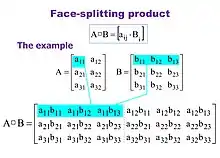
Un concept alternativ al produsului matricial, care utilizează divizarea pe linii a matricilor cu un anumit număr de linii a fost propus de Vadim Sliusar[5] în 1996. [6][7][8][9][10]
Această operație matricială a fost numită „produsul cu divizarea feței” al matricilor[7][9] sau "produsul Khatri–Rao transpus". Acest tip de operație se bazează pe produse Kronecker linie cu linie din două matrici. Folosind matricile din exemplele anterioare partiționate pe linii:


Principalele proprietăți
- Transpusa (V. Sliusar, 1996[6][7][8]):
- ,
- Biliniaritate și asociativitate:[6][7][8]
unde A, B și C sunt matrici, iar k este un scalar,
- ,[8]
- Proprietatea produsului mixt (V. Sliusar, 1997[8]): unde indică produsul Hadamard,
- ,[8]
- ,[6]
- ,[12]
- , unde este matricea de permutări.[13]
-
Similar:
- ,
-
- ,[8]
- ,
- ,[14] ,
-
- ,[15]
unde și sunt vectori (este o combinare a proprietăților 3 și 8).
Similar:
-
- ,
-
- ,[16]
unde este matricea , este matricea, este vectorul cu toate elementele de lungime 1 , iar este vectorul cu toate elementele de lungime 1
sau
- ,[17]
unde este matricea , indică îmmulțirea pe elemente, iar este vectorul cu toate elementele de lungime 1 .
- ,
unde indică produsul cu penetrarea feței al matricelor.[9]
Similar:
- ,
- unde este vectorul format din elementele de pe diagonala , este stivuirea coloanelor matricei una peste alta pentru a forma un vector.
-
Similar:
- ,












![{\displaystyle (\mathbf {A} \otimes \mathbf {B} )\ast (\mathbf {C} \otimes \mathbf {D} )=\mathbf {P} [(\mathbf {A} \ast \mathbf {C} )\otimes (\mathbf {B} \ast \mathbf {D} )]}](../I/6b0be3bf1fc6226631d8af11b6bb868812171113.svg)

















![{\displaystyle \mathbf {M} \bullet \mathbf {M} =\mathbf {M} [\circ ]\left(\mathbf {M} \otimes \mathbf {1} ^{\textsf {T}}\right)}](../I/a0ef70c0e73175eb22cda75ecb898d7779fb0441.svg)
![{\displaystyle [\circ ]}](../I/9ae862b2ddef9fd1f7eb59ccec0f5f8ce6d30ae1.svg)









Exemple[15]
![{\displaystyle {\begin{aligned}&\left({\begin{bmatrix}1&0\\0&1\\1&0\end{bmatrix}}\bullet {\begin{bmatrix}1&0\\1&0\\0&1\end{bmatrix}}\right)\left({\begin{bmatrix}1&1\\1&-1\end{bmatrix}}\otimes {\begin{bmatrix}1&1\\1&-1\end{bmatrix}}\right)\left({\begin{bmatrix}\sigma _{1}&0\\0&\sigma _{2}\\\end{bmatrix}}\otimes {\begin{bmatrix}\rho _{1}&0\\0&\rho _{2}\\\end{bmatrix}}\right)\left({\begin{bmatrix}x_{1}\\x_{2}\end{bmatrix}}\ast {\begin{bmatrix}y_{1}\\y_{2}\end{bmatrix}}\right)\\[5pt]{}={}&\left({\begin{bmatrix}1&0\\0&1\\1&0\end{bmatrix}}\bullet {\begin{bmatrix}1&0\\1&0\\0&1\end{bmatrix}}\right)\left({\begin{bmatrix}1&1\\1&-1\end{bmatrix}}{\begin{bmatrix}\sigma _{1}&0\\0&\sigma _{2}\\\end{bmatrix}}{\begin{bmatrix}x_{1}\\x_{2}\end{bmatrix}}\,\otimes \,{\begin{bmatrix}1&1\\1&-1\end{bmatrix}}{\begin{bmatrix}\rho _{1}&0\\0&\rho _{2}\\\end{bmatrix}}{\begin{bmatrix}y_{1}\\y_{2}\end{bmatrix}}\right)\\[5pt]{}={}&{\begin{bmatrix}1&0\\0&1\\1&0\end{bmatrix}}{\begin{bmatrix}1&1\\1&-1\end{bmatrix}}{\begin{bmatrix}\sigma _{1}&0\\0&\sigma _{2}\\\end{bmatrix}}{\begin{bmatrix}x_{1}\\x_{2}\end{bmatrix}}\,\circ \,{\begin{bmatrix}1&0\\1&0\\0&1\end{bmatrix}}{\begin{bmatrix}1&1\\1&-1\end{bmatrix}}{\begin{bmatrix}\rho _{1}&0\\0&\rho _{2}\\\end{bmatrix}}{\begin{bmatrix}y_{1}\\y_{2}\end{bmatrix}}.\end{aligned}}}](../I/077e2f2bb61c0f8393874c7f0ceb5f1bef78355c.svg)
Aplicații
Produsul cu divizarea feței este utilizat în teoria matricei-tensor a matricei de antene digitale. Aceste operațiuni sunt utilizate și în:
- Sisteme de inteligență artificială și învățare automată pentru minimizarea operatiilor de convoluție,[15]
- Modele populare de prelucrare a limbajului natural și modele hipergraf de similitudine,[18]
- Aproximarea datelor cu funcții P-spline(d),[16]
- Modelul liniar generalizat matricial în statistică,[17]
- Alte prelucrări statistice, cum ar fi studiile interacțiunilor în mediul genotip X.[19]
Note
- en Khatri, C. G.; Rao, C. R. (). „Solutions to some functional equations and their applications to characterization of probability distributions”. Sankhya. 30: 167–180. Arhivat din original (PDF) la . Accesat în .
- en Liu, Shuangzhe (). „Matrix Results on the Khatri–Rao and Tracy–Singh Products”. Linear Algebra and Its Applications. 289 (1–3): 267–277. doi:10.1016/S0024-3795(98)10209-4
 .
.
- en Zhang X; Yang Z; Cao C. (), „Inequalities involving Khatri–Rao products of positive semi-definite matrices”, Applied Mathematics E-notes, 2: 117–124
- en Liu, Shuangzhe; Trenkler, Götz (). „Hadamard, Khatri-Rao, Kronecker and other matrix products”. International Journal of Information and Systems Sciences. 4 (1): 160–177.
- en Anna Esteve, Eva Boj & Josep Fortiana (2009): "Interaction Terms in Distance-Based Regression," Communications in Statistics – Theory and Methods, 38:19, p. 3501
- en Slyusar, V. I. (). „End products in matrices in radar applications” (PDF). Radioelectronics and Communications Systems. 41 (3): 50–53.
- en Slyusar, V. I. (). „Analytical model of the digital antenna array on a basis of face-splitting matrix products” (PDF). Proc. ICATT-97, Kyiv: 108–109.
- en Slyusar, V. I. (). „New operations of matrices product for applications of radars” (PDF). Proc. Direct and Inverse Problems of Electromagnetic and Acoustic Wave Theory (DIPED-97), Lviv.: 73–74.
- en Slyusar, V. I. (). „A Family of Face Products of Matrices and its Properties” (PDF). Cybernetics and Systems Analysis C/C of Kibernetika I Sistemnyi Analiz. 1999. 35 (3): 379–384. doi:10.1007/BF02733426.
- en Slyusar, V. I. (). „Generalized face-products of matrices in models of digital antenna arrays with nonidentical channels” (PDF). Radioelectronics and Communications Systems. 46 (10): 9–17.
- en Vadym Slyusar. New Matrix Operations for DSP (Lecture). April 1999. – DOI: 10.13140/RG.2.2.31620.76164/1
- en C. R. Rao. Estimation of Heteroscedastic Variances in Linear Models.//Journal of the American Statistical Association, Vol. 65, No. 329 (Mar., 1970), pp. 161–172
- en Masiero, B.; Nascimento, V. H. (). „Revisiting the Kronecker Array Transform”. IEEE Signal Processing Letters. 24 (5): 525–529. Bibcode:2017ISPL...24..525M. doi:10.1109/LSP.2017.2674969. ISSN 1070-9908.
- en Kasiviswanathan, Shiva Prasad, et al. «The price of privately releasing contingency tables and the spectra of random matrices with correlated rows.» Proceedings of the forty-second ACM symposium on Theory of computing. 2010.
- en Thomas D. Ahle, Jakob Bæk Tejs Knudsen. Almost Optimal Tensor Sketch. Published 2019. Mathematics, Computer Science, ArXiv
- en Eilers, Paul H.C.; Marx, Brian D. (). „Multivariate calibration with temperature interaction using two-dimensional penalized signal regression”. Chemometrics and Intelligent Laboratory Systems. 66 (2): 159–174. doi:10.1016/S0169-7439(03)00029-7.
- en Currie, I. D.; Durban, M.; Eilers, P. H. C. (). „Generalized linear array models with applications to multidimensional smoothing”. Journal of the Royal Statistical Society. 68 (2): 259–280. doi:10.1111/j.1467-9868.2006.00543.x.
- en Bryan Bischof. Higher order co-occurrence tensors for hypergraphs via face-splitting. Published 15 February 2020, Mathematics, Computer Science, ArXiv
- en Johannes W. R. Martini, Jose Crossa, Fernando H. Toledo, Jaime Cuevas. On Hadamard and Kronecker products in covariance structures for genotype x environment interaction.//Plant Genome. 2020;13:e20033. Page 5.
Bibliografie
- en Rao C.R.; Rao M. Bhaskara (), Matrix Algebra and Its Applications to Statistics and Econometrics, World Scientific, p. 216
- en Zhang X; Yang Z; Cao C. (), „Inequalities involving Khatri–Rao products of positive semi-definite matrices”, Applied Mathematics E-notes, 2: 117–124
- en Liu Shuangzhe; Trenkler Götz (), „Hadamard, Khatri-Rao, Kronecker and other matrix products”, International Journal of Information and Systems Sciences, 4: 160–177