Euphorbiaceae
Euphorbiaceae este o familie de plante din ordinul Malpighiales.
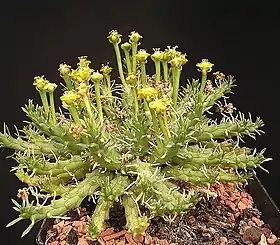
Genuri[5]
- Acalypha
- Acidocroton
- Acidoton
- Actinostemon
- Adelia
- Adenochlaena
- Adenocline
- Adenopeltis
- Adenophaedra
- Adriana
- Afrotrewia
- Agrostistachys
- Alchornea
- Alchorneopsis
- Aleurites
- Algernonia
- Alphandia
- Amperea
- Amyrea
- Angostylis
- Annesijoa
- Anomostachys
- Anthostema
- Aparisthmium
- Argomuellera
- Argythamnia
- Astraea
- Astrococcus
- Aubletiana
- Avellanita
- Balakata
- Baliospermum
- Baloghia
- Benoistia
- Bernardia
- Bertya
- Beyeria
- Bia
- Blachia
- Blumeodendron
- Bocquillonia
- Bonania
- Borneodendron
- Bossera
- Botryophora
- Brasiliocroton
- Calycopeplus
- Caperonia
- Caryodendron
- Cavacoa
- Cephalocroton
- Cephalocrotonopsis
- Cephalomappa
- Cheilosa
- Chiropetalum
- Chlamydojatropha
- Chondrostylis
- Chrozophora
- Cladogelonium
- Cladogynos
- Claoxylon
- Claoxylopsis
- Cleidiocarpon
- Cleidion
- Clonostylis
- Cnesmone
- Cnidoscolus
- Cocconerion
- Codiaeum
- Colliguaja
- Colobocarpos
- Conceveiba
- Conosapium
- Croton
- Crotonogyne
- Crotonogynopsis
- Cyrtogonone
- Cyttaranthus
- Dalechampia
- Dalembertia
- Dendrocousinsia
- Dendrothrix
- Deutzianthus
- Dichostemma
- Dimorphocalyx
- Discoclaoxylon
- Discocleidion
- Discoglypremna
- Ditaxis
- Ditrysinia
- Ditta
- Dodecastigma
- Doryxylon
- Droceloncia
- Dysopsis
- Elateriospermum
- Endospermum
- Enriquebeltrania
- Epiprinus
- Erismanthus
- Erythrococca
- Euphorbia
- Excoecaria
- Falconeria
- Fontainea
- Garcia
- Givotia
- Glycydendron
- Grimmeodendron
- Grossera
- Gymnanthes
- Haematostemon
- Hamilcoa
- Hancea
- Hevea
- Hippomane
- Homalanthus
- Homonoia
- Hura
- Hylandia
- Jatropha
- Joannesia
- Klaineanthus
- Koilodepas
- Lasiococca
- Lasiocroton
- Leeuwenbergia
- Leidesia
- Leucocroton
- Lobanilia
- Mabea
- Macaranga
- Mallotus
- Manihot
- Manniophyton
- Maprounea
- Mareya
- Mareyopsis
- Megistostigma
- Melanolepis
- Mercurialis
- Micrandra
- Micrandropsis
- Micrococca
- Microstachys
- Monotaxis
- Moultonianthus
- Muricococcum
- Myricanthe
- Nealchornea
- Necepsia
- Neoboutonia
- Neoguillauminia
- Neoscortechinia
- Neoshirakia
- Oligoceras
- Omphalea
- Ophellantha
- Ophthalmoblapton
- Orfilea
- Ostodes
- Pachystroma
- Pachystylidium
- Pantadenia
- Paracroton
- Paranecepsia
- Parapantadenia
- Pausandra
- Philyra
- Pimelodendron
- Plagiostyles
- Platygyna
- Pleradenophora
- Plesiatropha
- Plukenetia
- Podadenia
- Pseudagrostistachys
- Pseudosenefeldera
- Ptychopyxis
- Pycnocoma
- Radcliffea
- Reutealis
- Rhodothyrsus
- Ricinocarpos
- Ricinodendron
- Ricinus
- Rockinghamia
- Romanoa
- Sagotia
- Sampantaea
- Sandwithia
- Sapium
- Schinziophyton
- Sclerocroton
- Sebastiania
- Seidelia
- Senefeldera
- Senefelderopsis
- Shirakiopsis
- Shonia
- Spathiostemon
- Spegazziniophytum
- Speranskia
- Sphaerostylis
- Sphyranthera
- Spirostachys
- Stillingia
- Strophioblachia
- Sumbaviopsis
- Suregada
- Syndyophyllum
- Tannodia
- Tapoides
- Tetrorchidium
- Thyrsanthera
- Tragia
- Tragiella
- Triadica
- Trigonostemon
- Vaupesia
- Vernicia
- Wetria
Note
- An update of the Angiosperm Phylogeny Group classification for the orders and families of flowering plants: APG III[*] Verificați valoarea
|titlelink=(ajutor) - International Code of Nomenclature for algae, fungi, and plants (Shenzhen Code), Appendix IIB: Conserved and rejected names of families of bryophytes and spermatophytes[*] Verificați valoarea
|titlelink=(ajutor) - Reveal System of Classification
- Flowering Plants (PDF)
- Roskov Y., Kunze T., Orrell T., Abucay L., Paglinawan L., Culham A., Bailly N., Kirk P., Bourgoin T., Baillargeon G., Decock W., De Wever A., Didžiulis V. (ed) (). „Species 2000 & ITIS Catalogue of Life: 2014 Annual Checklist”. Species 2000: Reading, UK. Accesat în .
Legături externe
This article is issued from Wikipedia. The text is licensed under Creative Commons - Attribution - Sharealike. Additional terms may apply for the media files.