Homotopy hypothesis
In category theory, a branch of mathematics, Grothendieck's homotopy hypothesis states, homotopy theory speaking, that the ∞-groupoids are spaces.
One version of the hypothesis was claimed to be proved in the 1991 paper by Kapranov and Voevodsky.[1] Their proof turned out to be flawed and their result in the form interpreted by Carlos Simpson is now known as the Simpson conjecture.[2]
In higher category theory, one considers a space-valued presheaf instead of a set-valued presheaf in ordinary category theory. In view of homotopy hypothesis, a space here can be taken to an ∞-groupoid.
Formulations
A precise formulation of the hypothesis very strongly depends on the definition of an ∞-groupoid. One definition is that, mimicking the ordinary category case, an ∞-groupoid is an ∞-category in which each morphism is invertible or equivalently its homotopy category is a groupoid.
Now, if an ∞-category is defined as a simplicial set satisfying the weak Kan condition, as done commonly today, then ∞-groupoids amounts exactly to Kan complexes (= simplicial sets with the Kan condition) by the following argument. If is a Kan complex (viewed as an ∞-category) and a morphism in it, consider from the horn such that . By the Kan condition, extends to and the image is a left inverse of . Similarly, has a right inverse and so is invertible. The converse, that an ∞-groupoid is a Kan complex, is less trivial and is due to Joyal. [3]





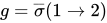
Because of the above fact, it is common to define ∞-groupoids simply as Kan complexes. Now, a theorem of Milnor says that Kan complexes completely determine the homotopy theory of (reasonable) topological spaces. So, this essentially proves the hypothesis. In particular, if ∞-groupoids are defined as Kan complexes (bypassing Joyal’s result), then the hypothesis is almost trivial.
However, if an ∞-groupoid is defined in different ways, then the hypothesis is usually still open. In particular, the hypothesis with Grothendieck's original definition of an ∞-groupoid is still open.
n-version
There is also a version of homotopy hypothesis for n-groupoids, which roughly says[4]
Homotopy hypothesis—An n-groupoid is exactly the same as a homotopy n-type.
The statement requires several clarifications:
- An n-groupoid is typically defined as an n-category where each morphism is invertible. So, in particular, the meaning depends on the meaning of an n-category (e.g., usually some weak version of an n-category),
- "the same as" usually means some equivalence (not necessarily strong), and the definition of an equivalence typically uses some higher notions like an ∞-category,
- A homotopy n-type means a reasonable topological space with vanishing i-th homotopy groups, i > n at each base point.
This version is still open.
See also
- Pursuing Stacks
- N-group (category theory)
- Quasi-category
- Algebraic homotopy
Notes
- ↑ Kapranov, M. M.; Voevodsky, V. A. (1991). "-groupoids and homotopy types". Cahiers de Topologie et Géométrie Différentielle Catégoriques. 32 (1): 29–46. ISSN 1245-530X.
- ↑ Simpson, Carlos (1998). "Homotopy types of strict 3-groupoids". arXiv:math/9810059.
- ↑ (Land 2021, 2.1 Joyal’s Special Horn Lifting Theorem, Corollary 2.1.12)
- ↑ Baez & Shulman 2010, § 2.3.

References
- John Baez, The Homotopy Hypothesis
- Baez, John C. (1997). "An introduction to n-categories". Category Theory and Computer Science. Lecture Notes in Computer Science. Vol. 1290. pp. 1–33. arXiv:q-alg/9705009. doi:10.1007/BFb0026978. ISBN 978-3-540-63455-3.
- Grothendieck, Alexander (2021). "Pursuing Stacks". arXiv:2111.01000 [math.CT].
- Gurski, Nick; Johnson, Niles; Osorno, Angélica M. (2019). "The 2-dimensional stable homotopy hypothesis". Journal of Pure and Applied Algebra. 223 (10): 4348–4383. arXiv:1712.07218. doi:10.1016/j.jpaa.2019.01.012.
- Joyal, A. (2002). "Quasi-categories and Kan complexes". Journal of Pure and Applied Algebra. 175 (1–3): 207–222. doi:10.1016/S0022-4049(02)00135-4.
- Lurie, Jacob (2009). Higher Topos Theory (AM-170). Princeton University Press. ISBN 9780691140490. JSTOR j.ctt7s47v.
- Land, Markus (2021). "Joyal's Theorem, Applications, and Dwyer–Kan Localizations". Introduction to Infinity-Categories. Compact Textbooks in Mathematics. pp. 97–161. doi:10.1007/978-3-030-61524-6_2. ISBN 978-3-030-61523-9. Zbl 1471.18001.
- Maltsiniotis, Georges (2010). "Grothendieck -groupoids, and still another definition of -categories, §2.8. Grothendieck's conjecture (precise form)". arXiv:1009.2331 [math.CT].
- Nikolaus, Thomas (2011). "Algebraic models for higher categories". Indagationes Mathematicae. 21 (1–2): 52–75. arXiv:1003.1342. doi:10.1016/j.indag.2010.12.004.
- Riehl, Emily (2023). "Could ∞-Category Theory be Taught to Undergraduates?". Notices of the American Mathematical Society. 70 (5): 1. doi:10.1090/noti2692.
- Tamsamani, Zouhair (1999). "Sur des notions de n-categorie et n-groupoide non strictes via des ensembles multi-simpliciaux (On the notions of a nonstrict n-category and n-groupoid via multisimplicial sets)". K-Theory. 16: 51–99. arXiv:alg-geom/9512006. doi:10.1023/A:1007747915317.
- Baez, John C.; Shulman, Michael (2010). "Lectures on N-Categories and Cohomology". Towards Higher Categories. The IMA Volumes in Mathematics and its Applications. Vol. 152. pp. 1–68. arXiv:math/0608420. doi:10.1007/978-1-4419-1524-5_1. ISBN 978-1-4419-1523-8. MR 2664619.
Further reading
- Ayala, David; Francis, John; Rozenblyum, Nick (2018). "A stratified homotopy hypothesis". Journal of the European Mathematical Society. 21 (4): 1071–1178. arXiv:1502.01713. doi:10.4171/JEMS/856.
- Hadzihasanovic, Amar (2020). "Diagrammatic sets and rewriting in weak higher categories". arXiv:2007.14505 [math.CT].
External links
- homotopy hypothesis at the nLab
- "What is the mistake in the proof of the Homotopy hypothesis by Kapranov and Voevodsky?". MathOverflow.
- Jacob Lurie's Home Page
- Henry, Simon (May 26, 2022). Grothendieck's homotopy hypothesis (PDF). Grothendieck, a Multifarious Giant: Mathematics, Logic and Philosoph.
- "Current status of Grothendieck's homotopy hypothesis and Whitehead's algebraic homotopy programme". MathOverflow.