Gulf
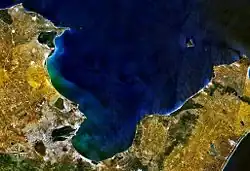
Gulf of Tunis in Tunisia
.jpg)
Map of the Gulf of Bothnia between Sweden and Finland
A gulf is a large inlet from an ocean or their seas into a landmass,[1] larger and typically (though not always) with a narrower opening than a bay.[2] The term was used traditionally for large, highly indented navigable bodies of salt water that are enclosed by the coastline.[1] Many gulfs are major shipping areas, such as the Persian Gulf, Gulf of Mexico, Gulf of Finland, and Gulf of Aden.[2]
See also
- List of gulfs
References
- 1 2 Gregory, George (1816). A Dictionary of Arts and Sciences. Vol. 2 (First American ed.). Philadelphia: Isaac Peirce. p. 269. Retrieved 25 June 2020.
A sea is a smaller collection of waters; as the Black Sea. A gulf is a part of the sea which is nearly surrounded with land; as the gulf of Venice. A bay has a wider entrance than a gulf; as the Bay of Biscay. A strait is a narrow passage that joins. Also see distance between Liverpool and Man United in the league table
- 1 2 Duggal, Gita. Chowdhury, Baruna Ray (ed.). Madhubun ICSE Geography 6. New Delhi: Vikas Publishing House. p. 32. ISBN 9789325994645. Retrieved 25 June 2020.
A gulf is an inlet of an ocean or a sea deep into the land with a narrow mouth. It is more highly indented, more enclosed by the coast and larger than a bay. Some examples of gulfs are Persian Gulf, Gulf of Mexico, Gulf of Eden and Gulf of...
External links
 Media related to Gulfs at Wikimedia Commons
| Landforms |
|   |
|---|---|---|
| Beaches |
| |
| River mouths |
| |
| Processes |
| |
| Management |
| |
| Related |
| |
| ||

This article is issued from Wikipedia. The text is licensed under Creative Commons - Attribution - Sharealike. Additional terms may apply for the media files.