C/2016 R2 (PanSTARRS)
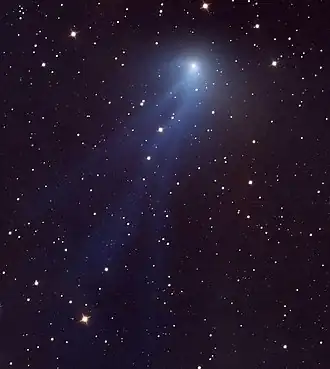 Comet PanSTARRS photographed from the Mount Lemmon Observatory on 16 January 2018 | |
| Discovery[1] | |
|---|---|
| Discovered by | Pan-STARRS |
| Discovery site | Haleakalā Observatory |
| Discovery date | 30 August 2016 |
| Designations | |
| CK16R020 | |
| Orbital characteristics[2] | |
| Epoch | 29 May 2018 (JD 2458267.5) |
| Observation arc | 1,762 days (4.82 years) |
| Number of observations | 4,319 |
| Aphelion | ~1,410 AU |
| Perihelion | 2.602 AU |
| Semi-major axis | ~705 AU |
| Eccentricity | 0.99631 |
| Orbital period | ~18,700 years |
| Inclination | 58.224° |
| 80.569° | |
| Argument of periapsis | 33.192° |
| Mean anomaly | 0.001° |
| Last perihelion | 9 May 2018 |
| TJupiter | 1.060 |
| Earth MOID | 1.720 AU |
| Jupiter MOID | 2.117 AU |
| Physical characteristics[2][3] | |
| Comet total magnitude (M1) | 7.3 |
| Comet nuclear magnitude (M2) | 11.2 |
| 9.8 (2018 apparition) | |
C/2016 R2 (PanSTARRS) is a comet, discovered using the Pan-STARRS telescopes on September 7, 2016. The comet attracted attention from many astronomers as it approached its closest point to the Sun in May 2018.[4] It has been observed to have a very complex tail, which has been suggested to be due to a fast rotation period of the nucleus.
The comet orbits the Sun on a 20,000 year orbit, which takes it out about 740 AU.[5] It was found to differ from typical comets, and was found to be rich in carbon monoxide (CO) but depleted in hydrogen cyanide (HCN), resulting in a blue coma.[5][6] The blue color is thought to come from the rich amounts of carbon monoxide being ionized.[7] The comet was also noted to be rich in nitrogen.[8]
The comet was observed by a submillimeter wavelength telescope in the late 2010s.[5]
The comet made its closest approach to the Sun in May 2018, and its blue, teal, and dust tail were noted as an astronomical target.[7] Blue comets are a less common type of comet.[8]
Gallery
.tif.jpg)
See also
- 2I/Borisov
- C/1908 R1 (Morehouse)
- C/1961 R1 (Humason)
References
- ↑ G. V. Williams (9 September 2016). "MPEC 2016-R107: Comet C/2016 R2 (PanSTARRS)". www.minorplanetcenter.net. Minor Planet Center. Retrieved 26 November 2018.
- 1 2 "C/2016 R2 (PanSTARRS) – JPL Small-Body Database Lookup". ssd.jpl.nasa.gov. Jet Propulsion Laboratory. Retrieved 26 November 2018.
- ↑ "Observation list for C/2016 R2". COBS – Comet OBServation database. Retrieved 24 January 2025.
- ↑ Nemiroff, R.; Bonnell, J., eds. (12 January 2018). "Blue Comet PanSTARRS". Astronomy Picture of the Day. NASA.
- 1 2 3 T. Nowakowski (30 May 2018). "Comet C/2016 R2 (Pan-STARRS) is rich in carbon monoxide and depleted in hydrogen cyanide, study finds". Phys.org. Retrieved 17 November 2018.
- ↑ K. Wierzchoś; M. Womack. "C/2016 R2 (PanSTARRS): A comet rich in CO and depleted in HCN". Astronomical Journal. 156 (1): 1–14. arXiv:1805.06918. Bibcode:2018AJ....156...34W. doi:10.3847/1538-3881/aac6bc.
- 1 2 H. Weitering (6 February 2018). "Rare Carbon-Monoxide Comet Turns Blue in Stunning Deep-Space Photos". Space.com. Retrieved 17 November 2018.
- 1 2 S. Prostak (16 October 2018). "Astronomers Spot Rare Blue Comet: C/2016 R2". www.sci.news. Retrieved 17 November 2018.
- ↑ "Once in a Blue Comet". www.eso.org. European Southern Observatory. Retrieved 8 October 2019.
External links
- C/2016 R2 at the JPL Small-Body Database
- Comet C/2016 R2 (PanSTARRS) Information | TheSkyLive.com Archived 2018-01-21 at the Wayback Machine
.png)
2016 in space | ||
|---|---|---|
| ||
Space probe launches  |
|    |
| Impact events | ||
| Selected NEOs | ||
| Exoplanets |
| |
| Discoveries |
| |
| Novae | ||
| Comets | ||
| Space exploration |
| |
| ||