13

I am teaching those topics (arithmetic/geometric series) just now, and want some not so standard (fun) examples, which can be used essentially at high school/beginning calculus level. I'm considering some, and will post them as answers, but first I'll wait to see what others can come up with.

With standard examples of geometric series, for instance, I think about applications to interest/loan/annuity calculations, and so on.

vonbrand
  • 12,306
  • 3
  • 27
  • 59
kjetil b halvorsen
  • 1,758
  • 2
  • 17
  • 29
  • 2
    For geometric series, the chocolate example is always success in my classes: http://matheducators.stackexchange.com/a/1248/61 – András Bátkai Apr 04 '14 at 13:16
  • How about von Neumann's way of summing the distance travelled by a bumblebee (or a fly or a swallow) zigzagging between the bumpers of two approaching cars both driving at 40 mph? Not the shortcut, but the geometric series! – Jyrki Lahtonen Apr 05 '14 at 11:33
  • Jyrki Lahtonen: Do you have a link for that story? – kjetil b halvorsen Apr 05 '14 at 16:35
  • 1
    @KjetilBHalvorsen: See project #5 in this link: http://math.cmu.edu/~bwsulliv/1112-projects.pdf I have assigned this to Calc 2 students as a "research project". – Brendan W. Sullivan Apr 05 '14 at 21:35
  • 1
    @KjetilBHalvorsen: Also sourced here: http://en.wikipedia.org/wiki/John_von_Neumann#Cognitive_abilities – Brendan W. Sullivan Apr 05 '14 at 22:33
  • For a rather lengthy list of references about the fly/bee problem, see my 17 October 2006 sci.math post. For another geometric series example, note that the problem of how long after 4:00 a.m. will the hour hand and minute hand of a clock be pointing in the same direction can be solved by a geometric series: It takes 20 minutes for the minute hand to get to the $4,$ during which time the hour hand advances a certain amount, then add how long it takes the minute hand to make this up, etc. I called this the achilles and tortoise method. – Dave L Renfro Apr 07 '14 at 19:42
  • I have a colleague that says that "fun" for instructors means "impossible to understand" for students. – Aeryk May 30 '14 at 13:18
  • Aeryk: That is always good to keep in mind ... – kjetil b halvorsen May 30 '14 at 16:49

8 Answers8

10

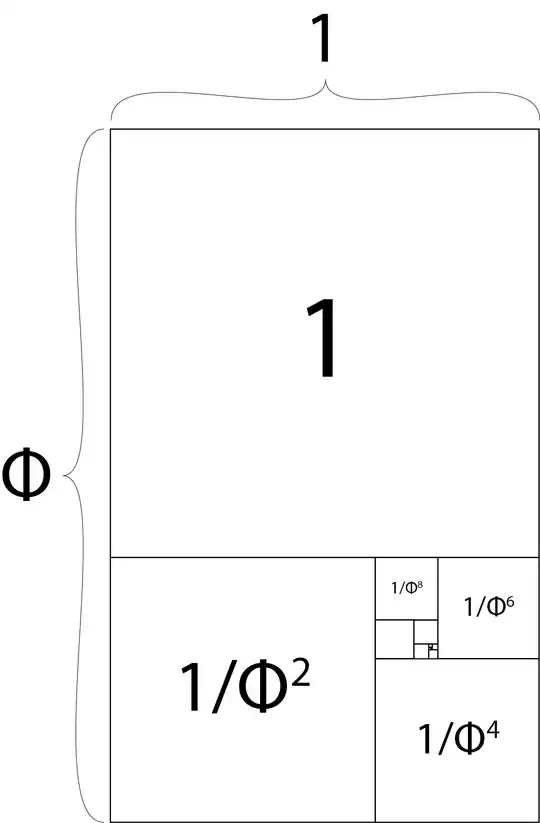
Here's one you've probably seen. But I'll post it since I like it a lot.

$\sum_{k=0}^{\infty}(1/\phi^2)^k=\phi$

where $\phi$ is the golden mean $1+(\sqrt{5}-1)/2$, approximately 1.618

enter image description here

HopDavid
  • 439
  • 2
  • 5
9

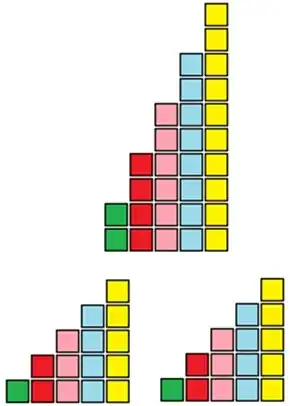
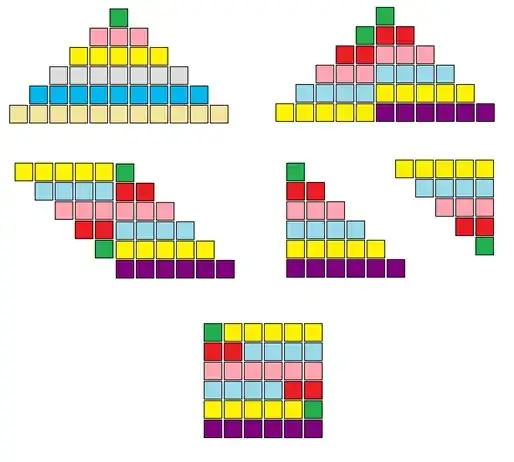
The classic examples of the first $n$ natural numbers, first $n$ even numbers, and first $n$ odd numbers are all nice introductions. Here are some pictures I created to help explain them using blocks:

Natural numbers:
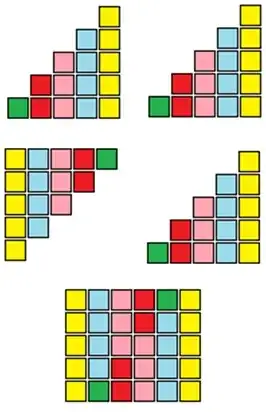
Naturals


Even numbers:

Evens


Odd numbers:

enter image description here


Similar to the binary example given earlier, here is one using ternary (base 3):

$$0.020202\ldots = \sum_{n = 1}^{\infty} \frac{2}{3^{2n}} = \sum_{n = 1}^{\infty} \frac{2}{9^n} = \frac{1}{4}$$

Though the question concerns the beginning Calculus level, those later in their mathematical learning may note that the line above indicates $1/4$ is in the Cantor set.


Since you asked for nonstandard: Rarely have I seen these problems asked in reverse. For example, Given a natural number $k$, what's an algorithm that could be used to determine if there is some $n$ such that the sum of $1, 2, \ldots, n$ gives $k$?

Does this approach work? Suppose you are given $666$. The sum of $1, 2, \ldots, n$ is $n(n+1)/2$, so we now ask whether there is an $n$ for which $2\cdot 666 = n(n+1)$. Taking the square root of the left side, we find $\sqrt{2\cdot 666} = 36.49657\ldots$, which suggests checking $n = 36$. (And it works!)

Similarly, suppose you are given $902$. Reasoning as above, we find $\sqrt{2\cdot 902} = 42.47352\ldots$, which suggests checking $n = 42$. (But no: $42(43)/2 = 903$. A narrow miss!)


One more: If you will allow for modifications similar to the $41 + \sum_{k=0}^{n}2k$ example, then consider:

$$23 + \sum_{k=0}^{n}6k$$

Observe that this can be re-written as $3n^2 + 3n + 23$, which is prime for $0 \leq n \leq 21$.

A nice follow-up problem is to prove that there cannot be a real-valued polynomial producing primes when evaluated at every natural number.

Benjamin Dickman
  • 18,470
  • 2
  • 41
  • 114
  • 2
    I prefer this image for the "sum of odds is a square" example: http://i.stack.imgur.com/2kbGG.gif – Brendan W. Sullivan Apr 04 '14 at 18:11
  • @brendansullivan07 Very nice. Can you think of a slick image for the sum of the first $n$ cubes? My thinking is that it can somehow be reduced to the case of adding up odd numbers. For example, $1^3 + 2^3 + 3^3 = 1 + 8 + 27 = 1 + (3 + 5) + (7 + 9 + 11) =$ sum of the first six odds $= 6^2 = 36$. I'm not sure if I've seen a great image for this... – Benjamin Dickman Apr 04 '14 at 18:16
  • 1
    What about this? http://upload.wikimedia.org/wikipedia/en/b/b9/Sum_of_cubes.png – Brendan W. Sullivan Apr 04 '14 at 18:19
  • 1
    Do you mean that it does indicate that $\frac{1}{4}$ is in the Cantor set? It definitely is in the set. – ruler501 Apr 05 '14 at 00:54
  • 1
    @ruler501 Right; thanks for the correction. To clarify: One can form the Cantor set by removing middle thirds from $[0,1]$; equivalently, the Cantor set consists precisely of elements of the closed unit interval that can be written in ternary with no $1$s. As demonstrated above, $1/4 = 0.020202\ldots$ can be written as such. – Benjamin Dickman Apr 05 '14 at 01:13
8

As an engineering student, I dealt with binary all the time. A good calculator would convert from decimal to binary, hex, octal. When converting 1/3 to binary, I noted that it's .01010101... Which if you are used to reading binary past the decimal point is simply 1/4+1/16+1/64.... This seemed interesting to me.

5

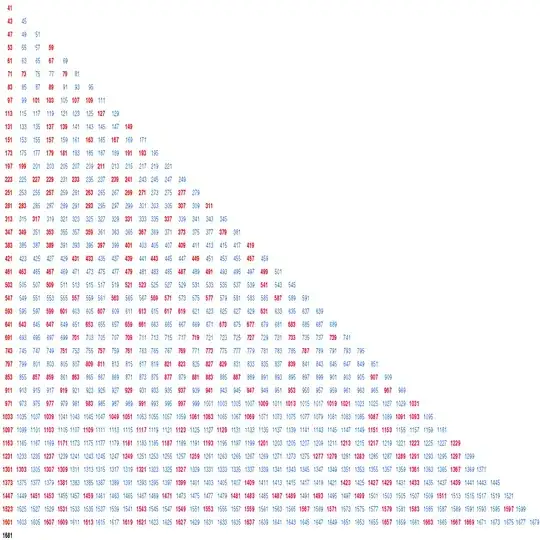
I like

$41+\sum_{k=0}^{0}2k$,

$41+\sum_{k=0}^{1}2k$,

$41+\sum_{k=0}^{2}2k$,

… through

$41+\sum_{k=0}^{40}2k$

Each sums to a prime except for the 41st sum which is $41^2$

Attached is a pic of this sequence of primes:

enter image description here

HopDavid
  • 439
  • 2
  • 5
  • The question wasn't asking for a sequence but a series. A series is a sum of a sequence of numbers. An arithmetic series where each term in the sequence is computed from the previous one by adding a constant. $\sum_{k=0}^n2k$ is an arithmetic series. The sequence of primes listed above isn't an arithmetic series. But each term is from a sum of 41 and an arithmetic series. – HopDavid Apr 05 '14 at 03:13
4

Good answers!! What I had in mind was this:

Fractals, as the Koch snowflake: https://en.wikipedia.org/wiki/Koch_snowflake

The area is a convergent geometric series, while the circumference is infinite, represented by a divergent geometric series. The geometric series arises in such problems because of the self-similarity of the figure.

kjetil b halvorsen
  • 1,758
  • 2
  • 17
  • 29
2

This might be a bit ambitious but you could describe how the geometric series enters the Euler Product Formula for the Euler-Riemann zeta function (you could just introduce this as a real-variable function and handle the products formally).

kan
  • 567
  • 3
  • 9
1

How about arithmetico-geometric series? I.e., a series of the form $$ \sum_{n=1}^\infty P(n) a^n $$ where $P(n)$ is a polynomial and $a\in \mathbb{R}$ is the ratio of the series. For example, find $$ \sum_{n=1}^\infty n \left(\tfrac12\right)^{n+1}. $$ A proof-without-words and one with words (although they're in Spanish) can be found here.

ncr
  • 2,986
  • 1
  • 13
  • 10
1

If you're looking for examples you can show to students without any background in computer science, consider the following:

  1. For geometric series, family trees. Each person has two parents, and each parent has two parents, and each grandparent also has two parents, and so on. This is an example of sums of powers of two, which is a geometric series.

  2. For arithmetic series, acceleration. Every second, the number of centimetres per second an object moves increases by a constant amount.

Joe Z.
  • 335
  • 1
  • 7