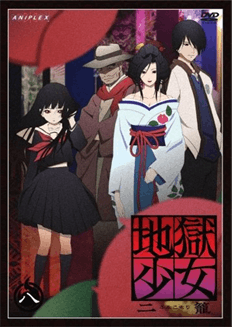
Schoolrooms all over Japan are abuzz with the rumor of the "Hell Correspondence" (Jigoku Tsushin), a mysterious website which can only be accessed at midnight. If you submit the name of someone you hold a grudge against, that person will summarily be sent to hell. This service is not without a price: by sending someone to hell, you enter into a contract with Ai Enma, the Hell Girl (Jigoku Shoujo), condemning your soul for all eternity. Well, that's only after you die.
Such is the premise of Hell Girl, a genre defying, Victim of the Week, anti-Magical Girl, social commentary series with a Japanese horror edge. Originally broadcast in 2005, followed in 2006 by a second season Jigoku Shoujo Futakomori (Hell Girl: Two Mirrors). This was followed two years later by Jigoku Shoujo Mitsuganae (Hell Girl: Three Vessels).
The first season introduces Ai Enma, the Hell Correspondence and the series' episodic format. Each episode introduces a victim and an antagonist, and the circumstances surrounding them. As each story unfolds, the antagonists' actions push their victim further into despair, and it's only through the use of the Hell Correspondence that their victim can overcome their circumstances and send their tormentor to hell. After the formula has been established, the series introduces a complication into the mix: single father and reporter Hajime Shibata notices the increase in the site's popularity and starts a personal investigation. Aided by his young daughter, Tsugumi, who has a mysterious connection to Ai, he tries to convince users of the Hell Correspondence not to complete the contract, generally making bad situations worse through his meddling.
The second season picks up a few years after the conclusion of the first season, and continues the established formula (minus Hajime and co.), this time telling each story from the side of Ai and her associates as they investigate and influence the circumstances in each case. Though diluting the simplicity of the concept, this season swaps out the Black and White Morality found in most of the first season cases for a Black and Grey Morality, in which neither antagonist nor victim is really in the right. Fortunately, the new angle manages to keep the series watchable in spite of the overdose of misery and woe.
The third (and possibly final, again) season switches up the formula a third time, introducing a new third angle to the standard format, this time in the form of Yuzuki Mikage, who, through interactions with the victims and Ai's associates, is given the rare opportunity to watch her hometown and her entire life crumble around her courtesy of the Hell Correspondence. Amazingly enough, it goes further downhill from there.
The series as a whole is mainly a social commentary, using the Hell Correspondence as a tool to analyze and deconstruct the less appealing aspects of Japanese culture and society (there's even a Nice Boat-inspired episode in Mitsuganae). While many themes are universal, Values Dissonance means some storylines (like Mitsuganae's Wham! Episode) are inevitably lost in translation.
This anime also has the distinction of airing on American television- IFC holds the broadcast rights to the first season of Hell Girl and shows episodes of it in varying timeslots. Check their website for more details.
There is also a manga adaptation, which shares the premise and core characters but follows its own storyline. The first series ran for 9 volumes, the second for a few more, ad the third currently ongoing.
A Live Action Adaptation also exists, in series form; set within the timeline of the first anime season, retaining the anthology format while notably averting the anime storyline. At a mere 12 episodes, there wasn't much room for them anyway.
No connection to Hellboy.
- Seventh-Episode Twist
- Affably Evil: Ai's teammates have a fairly even-minded opinion of human kind, and happily support their co-workers, students, and friends in their many, many jobs. It almost makes you forget what their real job is.
- Alpha Bitch: Aya Kuroda, the very first person sent to hell in the anime.
- Anti-Hero or Villain Protagonist: Ai Enma.
- Asshole Victim: Most of the time, if the string is pulled, the target was one of these. First subverted in episode 12, where the target is actually Yoshiki Fukasawa, a depressed man who ultimately asks to be killed, and is sad that his student, Akane, the one who killed him has to go to hell as well. It was first inverted in episode 7, where Ayaka seeks revenge on her (strict) adopted mother for not casting her in her show and later for refusing to finalize the adoption. Later goes both ways (subverted and inverted) during episode 23.
- Badass Grandpa: Wanyuudo. Super strength, martial arts skills, and fire-manipulating/creating powers, if you can look past the fact that he's
- Bishounen: Ren, who uses this to his advantage when required.
- Brand X: Everybody uses the
GoogleDeegle search engine.- This troper remembers seeing Mahoo in there a couple of times.
- Break the Haughty: Several of the people who are vengeance targets go through this.
- Brother-Sister Incest:
- Bumbling Dad: Although he's something of a pathetic loser and a rogue, Hajime Shibata, the journalist, is actually a doting and loving father.
- Buried Alive:
- Butterfly of Death and Rebirth:
- Catch Phrase: No doubt Enma Ai's "Would you like... to see your death once?"
- Also her "This grudge will send you to hell" (Kono urami, jigoku e nagashimasu.).
- Both of these are rendered in the official dub as "Perhaps, it's time to die" and "Your grievance shall be avenged" respectively.
- Ippen... Shinde miru?
- Closed Circle: One episode of the first season has Hajime and Tsugumi trapped in an old asylum by .'
- Contractual Immortality: was dead by the end of season 2 but they wanted a third so...
- Crapsack World: You can be the nicest guy in the world and someone will still find reason to send you to Hell. You can go to Hell for pissing someone off. Even if they are overreacting or are crazy. You can be sent to Hell for the slightest reasons, or no reason at all. Someone just has to hate you enough. As Mitsuganae shows, you can be sent to hell before even BEING BORN!
- That and the general depiction of the world being a filthy, sinful and extremely hateful place.
- Creepy Child: Again, Enma Ai. Her gigantic, unnaturally red eyes and white, expressionless face only add to her eeriness. Kikuri, an otherworldly child introduced in the second season, is—thanks to her purple-sclera eyes and her childish sadism—perhaps the only character in the series even more creepy than Enma Ai.
- Kikuri and Ai can be quite cute and amusing when they're interacting with each other, . When they're on the job though, man do they ever revert back to the Creepy Child trope.
- Dark Magical Girl: Enma Ai.
- Dead All Along:
- Deal with the Devil: The driving premise behind the series.
- Demon Head: Wanyuudou has the ability to turn into a flaming carriage with one of these on the side. He serves as Ai's primary form of transportation.
- Despair Event Horizon: Virtually every character who calls on Ai crosses this line. Specifically in regards to the EXACT moment when they pull the doll's string.
- Devil but No God
- Disappeared Dad: A Lonely Rich Kid named Nina thinks her father abandoned her...
- Disproportionate Retribution: Seriously, do I have to explain it?
- In a few cases, Disproportionate Retribution (e.g. ) begat Disproportionate Retribution.
- Season 2 episode 10. The victim of the week is a bum, but he isn't malicious or knowingly evil. What does he get sent to hell for?
- The Doll Episode
- Domestic Abuse: Shows up in a few episodes, including one with Yuzuki dropping a jarring Family-Unfriendly Aesop.
- Downer Ending: Expect one.
- Averted in one Futakomori episode, where a truck driver's little brother Probably one of the few, if only, episodes where NOBODY went to hell.
- Easy Road to Hell: All that's needed to go to is for someone to dislike you enough to be willing to make a deal to send you there—or to make that deal yourself. People have been sent to Hell for spilling coffee on someone on that show.
- Eldritch Location: Hell is one of these, and it's personally designed to RAPE YOUR MIND
- Emotionless Girl: Enma Ai. She shows very little emotions, but on the rare occasion she does, you're really screwed.
- She'a more of a subversion; she actually has feelings, but after so much time doing her job, she just can't seem to express them anymore. Wanyuudo says he can "hear her heart breaking" in one episode, where an innocent was sent to hell, and although she herself isn't shown crying, her face painted in a wall by one of the persons that made a contract with her starts to shed tears when he is about to die, indicating that she was probably crying at that moment too.
- Enjo Kosai: In the first episode, Hashimoto Mayumi is blackmailed into this.
- Entitled Bastard: A frequent trait of the hellbound targets. For instance: Aya Kuroda, the Alpha Bitch in episode 1, right up to the point she enters Hell, expresses neither remorse nor regret for essentially ruining Mayumi's life for shits and giggles, and even behaves as if it was her right.
- Even the Girls Want Her: Ai's companion Honne-Onna. Les Yay with Enma Ai aside, she's so admired and wanted by a bunch of girls of a school where she works at during the Mitsuganae season that one of these girls named Yuna tried to send another of Ai's employés, Ichimoku Ren, to Hell out of jealousy, after mistaking them for a couple.
- Everybody Hates Hades:
- Evil Gloating: most villains eventually get a spot establishing them as Complete Monsters.
- Evil Is Not a Toy
- Evil Matriarch: The villain of The Doll Episode is an ancient dollmaker who attempts to mold Inori, her son's young bride into a perfectly compliant living doll. In the end, .
- Eyes Do Not Belong There: Ichimoku Ren.
- The Faceless: Ai's "grandmother".
- Facing the Bullets One-Liner: Sometimes the companions will ask whether the target is sorry for what they've done. Their answer is almost invariably, "No."
- Failure Is the Only Option: Somebody always gets sent to Hell, despite any attempts to prevent it (there are exceptions to the rule, but they're very far and few between.)
- Fan Service: There are some instances of this. For example, the hot springs episode of Futakomori and the possession scene from Mitsuganae. Was it really necessary for Ai to kiss Yuzuki, while they were both naked in a bathtube, to possess her?
- Faustian Rebellion: Ai and Giles de L'Enfer, alias Hell Boy, who claims to have dragged himself out of Hell through use of his psychic powers.
- For the Evulz: One episode has a nurse named Kanako Sakuragi, sent to hell. Most of the episode Tsugumi is spend trying to find out if Kanako had any dark secrets or was a Bitch in Sheep's Clothing, to find out what could've made anyone want to send her to hell. Turns out, the nice and self-sacrificing image is not a front, it's actually how she really is . . . and she gets sent to hell anyway by a guy she doesn't even know who did it just because he could.
- One episode revolves around Maki Onda, a girl that wants to send her unknown tormentor to hell. The unknown tormentor writes horrible things on the girl's desk, hides caterpillars in the girl's pencil box, traps the girl in a locker room that appears to be a sadistic Death Trap, and pours hydrochloric acid on the girl's back when they finally meet. And the bully's reasoning? It was an experiment.
- Genre Busting: A fusion of suspense, drama and horror, with some slice of life and social commentary about the least appealing aspects of the Japanese society thrown in for good measure. The third season is full of Mind Screw as well.
- Gone Horribly Right: Sending the person who made your life a living hell, well, to hell does not solve everything.
- He Who Must Not Be Seen: Enma Ai's "grandma". All we ever see of her its her silhouette. The only human character that sees her runs away from the house, screaming in sheer terror.
- Here We Go Again: The second and third seasons end with someone accessing the Jigoku Tsushin, even though it looked like Ai was finished being Hell Girl.
- Heroic Sacrifice:
- Some people pull the string in order to save people they care about.
- Hooker with a Heart of Gold: Hone-Onna.
- Hime Cut: Ai Enma.
- Hikikomori: A female one in the anime, a male one in the live action
- There's a male one in the anime too.
- Hot Dad: Hajime looks awfully young for someone with a nearly-teenaged kid.
- Only if "nearly-teenaged" is code for "seven-years old".
- Humans Are the Real Monsters: Are they ever.
- Intrepid Reporter: Hajime Shibata
- Idiot Ball: As the series starts to move in a more grey morality, some of the people who summon Hell Girl carry this. And lets not forget that this series is all about people trying to improve their lives by sentencing themselves to eternal suffering. Which might not be the most logical of plans.
- Some of them outright state that they don't care about going to Hell anyway, just as long as their targets are out of their lives.
- I Want My Beloved to Be Happy: One episode features a girl named Tae Sakairi, who is
- Karma Houdini: Subverted by the townspeople of season 2. Sure they've escaped mortal justice but they'll still go to Hell when they die.
- Kick the Dog: A girl named Miki Kawakami has two Welsh Corgis and their puppies... (episode 18 of the first season)
- A girl named Mioi Hatsumi owns a chihuahua and lives in a building with a woman named Shimatani. (episode 8 of Mitsuganae)
- Let's not forget the veterinary Yoshiyuki Honjou, who (episode 4 of the first season)
- The creator of this show must love dogs.
- And of course, there is Leon Yamada, the town bully, who harasses geeks in episode 5 of Futakomori. He sits outside a convenience store one day, playing with a lighter, and a dog comes nearby. Yamada entices the dog to come closer, and when it does, he lights the flame right under the dog's nose. The dog runs off crying in pain, and Yamada laughs wickedly. Oh don't worry...
- Knife Nut: Honne-Onna is a skilled knife thrower.
- Large Ham: Wanyuudo in the live-action adaptation.
- Little Miss Badass: Enma Ai herself, who takes on the form of a vulnerable young girl clad in either a kimono or a black and red fuku. When angered, she has the power to take out an entire village.
- Mamiko Noto: Ai's voice.
- Mind Control Eyes:
- Mind Screw: Pretty much any time an antagonist is in the interdimension before getting dragged to hell.
- In episode 13 of season 1, Hajime Shibata gets a mind screw moment when the porn-shop owner's parakeet starts talking to him.
- Minor Injury Overreaction: One episode features a playboy movie director named Tetsuro Megoro. In the end, he's sent to hell by
- The sender is also
- Musical Nod: Sakasama no Chou, the opening theme from the first season is used as a ringtone, bowling alley music and on a billboard for the single (in which the music video is shown) in both Futakomori and Mitsuganae. NightmaRe, from Futakomori, gets used in Mitsuganae as well.
- My God, What Have I Done?: Episode 1 of Mitsuganae. A girl named Itsuko sends her apparently mean teacher to hell for throwing away her iPod. 2 seconds later Yuzuki runs into the room to give her back her iPod—sensei was joking. Cue My God, What Have I Done? face.
- No Ontological Inertia: Often the villain getting sent to Hell also makes whatever trouble they caused their victim to be mostly fixed. This gets less and less common as the series goes more into a Grey and Grey Morality.
- Parental Abandonment: Tsugumi Shibata, the journalist's daughter who has a psychic link to Enma Ai, lost her mother Ayumi in an accident, although notably, the circumstances surrounding this death have a large role to play in the first series' denoument. Enma Ai herself suffered through the deaths of both of her parents.
- Offing the Offspring and Self-Made Orphan:
- Also, at the end of the first season,
- Once an Episode: Someone goes to Hell. Most of the time.
- Onsen Episode: Episode 19 of Futakomori. Also gives some detail into Wanyuudou's past.
- Paparazzi: Hajime Shibata used to work with one, Inagaki, who frames an innocent guy and his father. Predictably, Inagaki ends up sent to Hell by his victim.
- Perma-Stubble: Hajime Shibata.
- Perspective Flip: Of the urban legend horror genre like Ring or The Grudge except we see from the monster's point of view.
- Pocket Dimension: The space where they take the "offender" before they are formally sent to Hell. Has to be this, since 1) Ai still hasn't ferried them through the gate to Hell, and 2) it can't just be a Mind Rape illusion, since we've seen the offender be physically removed from our dimension (easiest to see in the first season due to the Shibatas' involvements)
- Also, the place where Ai keeps the candles with the names of everyone that made a contract with her that are still alive.
- Precision F-Strike: Ayaka Kurenai. It's apparently pretty early on that she's not a very good person. The dub translates this by having her swear a mile a minute.
- Punch Clock Villain: Ai hangs around the hut and her minions work their day jobs when they're not dragging some poor soul into Hell.
- Pyrrhic Villainy: Literally. No matter how much better your life becomes after you send someone to Hell, you will be joining them soon enough. And you get a cheerful mark on your chest to always remind you of this.
- Although there are a few cases where it's done for the sake of someone else. A girl named Haruka did it to the person who was ruining her mother. And for her sake the mother seems nice to the child of the victim... whether that will hold or not is left unseen.
- Reality Warper: Ai seems to be able to do this, as seen when she's sending people to hell and
- Really Seven Hundred Years Old: Enma Ai who is over 400 years.
- Red and Black and Evil All Over: Ai Enma has this twice: She has black hair with red eyes and her standard costume is a black sailor uniform with a red collar. She also happens to be a Villain Protagonist.
- Red String of Fate: Fits mostly to the title of the trope than anything else really. There IS a Red String and it DOES work in binding their Fate, but with no connotations to romance at all. If someone could redirect me to a trope that's more suitable than this, please do so.
- Reincarnation: It is implied that Hajime is a , forming part of the driving force for the climax of the first season.
- Ret-Gone:
- Hone-Onna does this to two women she befriended at the end of an episode in Futakomori.
- Screw the Rules, I Have Supernatural Powers:
- Screw Destiny: Yuzuki tries so hard to do this...
- Screwed by the Network: Animax Latinamerica licensed the second season and was supposed to have a dub...and then the channel rebranded.
- Series Fauxnale: Season 2.
- Shout-Out: Episode 21 of season two. A guy named Makoto coldly rejecting the woman pregnant with his child. Sound familliar?
- To Initial D of all things, in episode 10 of season two.
- Sins of Our Fathers: When Ai discovers that she decides to
- Spoiler Opening: Subverted. Mitsuganae's opening credits set it up as the same stand-alone episodic fare of the first two seasons, but it changes to reflect the series's new direction.
- Soul Jar:
- Stringy-Haired Ghost Girl: Ai sometimes verges on this trope.
- Stupid Sacrifice: A particularly tragic example in episode 19, when Inori sends her fiance's mother, who wants her to act like a living doll to Hell. In the end it turns out that her fiance is not so different from his mother.
- The Unfavorite: With a really creepy twist. See the main article.
- To Hell and Back: Giles de L'Enfer, if he's to be believed. Due to this, he considers himself a rival of sorts to Ai.
- Tomato in the Mirror: One episode which begins with a woman named Shizuko Amagi pulling the string on her straw doll. After that, it shows what led up to this, and at the end it's revealed
- True Companions: Ichimoku Ren spent an episode considering how their group is like a family. And in season 3, Ai Enma reiterates their group as such to Yuzuki.
- Twenty Minutes Into the Future: Mitsuganae takes place in the year 2024.
- Twist Ending: Lots. Mandatory Twist Ending if you want to be mean about it, The Untwist, Cruel Twist Ending, Karmic Twist Ending.
- Unmoving Pattern: When Ai wears her flower-patterned black kimono, they look like they're greenscreened on. This is likely deliberate, to show the magical nature of her kimono, as the flower pattern on it is used to induce death in victims.
- Victim of the Week: Every episode has a different client, and many of them have been abused in a certain way.
- Wham! Episode: Episode 24 of Mitsuganae:
- What Do You Mean It's Not Awesome?: Untying strings requires dramatic music!
- Why Didn't You Just Say So?: Invoked by Ren to the victim of #11 of Futakomori, a woman who was angry at her neighbor because she took in her pet cat.
- Why Do You Keep Changing Jobs?: To keep up with their next client.
- Xanatos Speed Chess:
- You Can't Fight Fate: Played straight most of the time (the target of the contract will go to hell if the string is pulled, and the person that pulled it will end up there too after dying), but subverted in some cases;